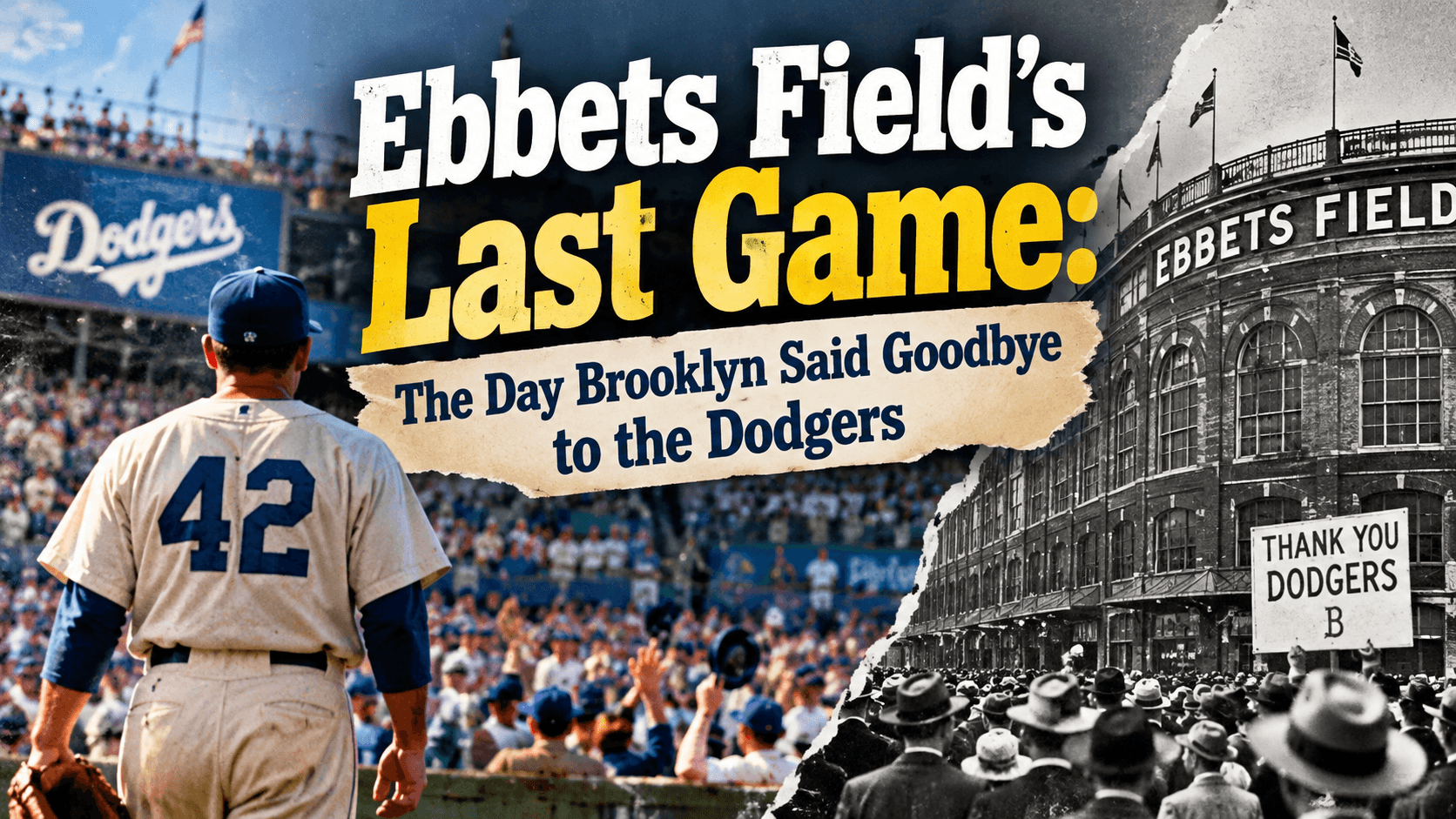
For generations of Brooklyn baseball fans, Ebbets Field was more than a ballpark. It was part of the neighborhood. Families walked through its gates, children grew up following the Dodgers, and some of baseball’s most important moments unfolded on its field.
That is why the last Brooklyn Dodgers game at Ebbets Field still carries so much emotion.
The Dodgers played their final game at Ebbets Field on September 24, 1957, defeating the Pittsburgh Pirates 2–0. At the time, no elaborate farewell ceremony marked the occasion. Yet history would turn that ordinary-looking Tuesday night into one of the most significant games ever played in Brooklyn.
When Was the Last Game at Ebbets Field?
The final Major League Baseball game at Ebbets Field was played on September 24, 1957, between the Brooklyn Dodgers and Pittsburgh Pirates.
Brooklyn won 2–0.
Only 6,702 fans attended the game, a surprisingly small crowd considering what the night would later represent. But the Dodgers’ departure for Los Angeles had not yet been treated as the kind of carefully planned farewell that modern sports fans might expect.
There were no season-long goodbye celebrations, no massive postgame ceremony, and no packed stadium filled with fans trying to experience Ebbets Field one last time.
Instead, the Dodgers simply played baseball.
When the final out was recorded, most people in attendance could not fully appreciate how dramatically Brooklyn baseball was about to change.
Who Pitched the Final Game at Ebbets Field?
One of the most important names from Ebbets Field’s last Dodgers game is Danny McDevitt.
McDevitt started for Brooklyn and pitched a complete-game shutout against Pittsburgh. His performance gave the Dodgers a 2–0 victory and earned him a permanent place in baseball history.
He became the last Dodgers pitcher to win a game at Ebbets Field.
For a player early in his Major League career, it was an unusual historical distinction. Decades later, McDevitt’s name remains closely connected with the closing chapter of the famous Brooklyn ballpark.
What Happened During the Final Out?
The final play helped give longtime Dodgers fans one more familiar connection to the team they had followed for years.
When the last out was made, the Dodgers had completed a shutout victory at home. The game itself looked like another late-season contest on the schedule.
Its meaning became much greater almost immediately afterward.
There would be no Brooklyn Dodgers home opener at Ebbets Field in 1958.
The franchise was headed west.
Why Did the Dodgers Leave Brooklyn?
The Dodgers’ move from Brooklyn to Los Angeles was not caused by a single issue.
By the 1950s, Ebbets Field presented several challenges. It was an aging ballpark with limited parking, limited room for expansion, and a relatively modest seating capacity compared with newer stadium possibilities.
Dodgers owner Walter O’Malley wanted a modern stadium that the team could control.
O’Malley hoped to build a new ballpark in Brooklyn, particularly in an area near Atlantic and Flatbush Avenues. The proposed project became tied up in disagreements involving land acquisition, public authorities, political leadership, transportation, and the role government should play in assembling the property.
At the same time, Los Angeles was eager to bring Major League Baseball to Southern California.
The opportunity eventually became too significant for the Dodgers to ignore.
After the 1957 season, the Brooklyn Dodgers officially became the Los Angeles Dodgers.
The New York Giants also moved west, becoming the San Francisco Giants.
For New York baseball fans, it meant that two National League franchises with deep local histories disappeared from the city at almost the same time.
Why Was Ebbets Field So Important?
Understanding the final game requires understanding what Ebbets Field meant to Brooklyn.
The ballpark opened in 1913 and became one of baseball’s most recognizable homes. Located in the Flatbush section of Brooklyn, it was built into a densely populated urban neighborhood rather than surrounded by enormous parking lots.
Its relatively intimate dimensions helped create a close relationship between players and spectators.
Fans were near the action. Players became neighborhood figures. The Dodgers were not simply a team that happened to play in Brooklyn. For many residents, they were an expression of Brooklyn itself.
The team’s nickname, “Dem Bums,” was affectionate rather than insulting. It reflected the unusually personal relationship between Brooklyn supporters and their club.
Jackie Robinson Changed Baseball at Ebbets Field
No history of Ebbets Field is complete without Jackie Robinson.
On April 15, 1947, Robinson made his Dodgers debut at Ebbets Field, breaking Major League Baseball’s modern color barrier.
That moment transformed baseball and became an important event in the broader history of American civil rights.
Robinson faced racism from opposing players, spectators, hotels, communities, and others around the sport. Despite those obstacles, he became one of baseball’s greatest players and helped the Dodgers become a dominant National League team.
His career made Ebbets Field important for reasons extending far beyond wins and losses.
When people remember the stadium today, they are remembering not just an old Brooklyn ballpark but a place where an important part of American history unfolded.
The Dodgers Finally Beat the Yankees in 1955
Another defining moment came during the 1955 World Series.
Brooklyn had repeatedly suffered heartbreaking defeats against the New York Yankees. The phrase “Wait till next year” became closely associated with frustrated Dodgers supporters.
In 1955, next year finally arrived.
The Dodgers defeated the Yankees in seven games to win the franchise’s first World Series championship.
The deciding Game 7 was played at Yankee Stadium, but the championship belonged deeply to Brooklyn and to generations of fans who had followed the Dodgers at Ebbets Field.
Players from that era—including Jackie Robinson, Duke Snider, Pee Wee Reese, Roy Campanella, Gil Hodges, Carl Furillo, and others—became permanent parts of Brooklyn baseball history.
Just two years after that long-awaited championship, the team’s final Ebbets Field game was played.
That short gap helps explain why the Dodgers’ departure was especially painful.
Did Fans Know the September 24 Game Would Be the Last?
The possibility of the Dodgers leaving Brooklyn was widely discussed during 1957, so the issue was not a complete surprise.
However, the final home game was nothing like the carefully marketed stadium farewells familiar to modern sports fans.
There was uncertainty surrounding the team’s future, and the emotional significance of September 24 became clearer afterward.
That helps explain the attendance of just 6,702.
Today, a final game at a historic stadium would probably attract enormous demand, television coverage, commemorative merchandise, former players, and a lengthy ceremony.
Ebbets Field’s farewell was remarkably different.
Its final Major League game ended quietly.
What Happened After the Last Ebbets Field Game?
The Dodgers finished the remainder of their 1957 schedule away from Brooklyn.
Soon afterward, their move to California became reality.
The 1958 season was the Dodgers’ first in Los Angeles. The franchise initially played home games at the Los Angeles Memorial Coliseum before moving into Dodger Stadium in 1962.
Brooklyn, meanwhile, was left without its beloved National League team.
New York would eventually receive a new National League franchise when the New York Mets began playing in 1962. The Mets deliberately incorporated elements of New York’s former National League clubs into their identity, including connections to both the Dodgers and Giants.
But for Brooklyn fans, the Mets could not erase what had been lost.
What Happened to Ebbets Field?
Ebbets Field remained standing for a few years after the Dodgers left.
The stadium was eventually demolished in 1960.
Housing was later built on the property, permanently changing the physical appearance of the site.
Someone visiting the area today will not find the grandstands, scoreboard, outfield walls, or famous rotunda that baseball fans once knew. What remains is the history attached to the location and the memories preserved through photographs, broadcasts, memorabilia, books, museums, and family stories.
That disappearance is part of what makes Ebbets Field so fascinating.
Unlike Fenway Park or Wrigley Field, fans cannot walk into a preserved Ebbets Field and experience the building themselves. The stadium survives primarily through historical records and collective memory.
Why Does Ebbets Field’s Last Game Still Matter?
The significance of September 24, 1957, goes far beyond the final score.
The game marked the end of a relationship between a baseball club and a community that had developed over several generations.
It also represented a major shift in professional sports.
Baseball was expanding geographically. Population patterns were changing. Television was changing how fans experienced games. Cars and suburban development were reshaping American cities. Team owners increasingly looked toward larger markets and modern stadium opportunities.
The Dodgers’ move to Los Angeles helped establish Major League Baseball firmly on the West Coast.
From a business perspective, the relocation became enormously important to the Dodgers and to baseball.
From Brooklyn’s perspective, however, success in California did little to reduce the sense of loss.
Both parts of the story matter.
Ebbets Field Last Game: Key Facts
For readers looking for the essential information, these are the main facts:
- Date: September 24, 1957
- Teams: Brooklyn Dodgers vs. Pittsburgh Pirates
- Final score: Dodgers 2, Pirates 0
- Location: Ebbets Field, Brooklyn, New York
- Attendance: 6,702
- Winning pitcher: Danny McDevitt
- Significance: Final Major League Baseball game played by the Brooklyn Dodgers at Ebbets Field
- Dodgers’ next home city: Los Angeles
- Ebbets Field demolished: 1960
Frequently Asked Questions
What was the last Dodgers game played at Ebbets Field?
The Brooklyn Dodgers played their final Ebbets Field game on September 24, 1957. They defeated the Pittsburgh Pirates 2–0.
Who won the last game at Ebbets Field?
The Brooklyn Dodgers won, beating Pittsburgh 2–0.
Who was the final winning pitcher at Ebbets Field?
Danny McDevitt pitched a complete-game shutout for Brooklyn and earned the victory.
How many people attended the last Dodgers game at Ebbets Field?
The reported attendance was 6,702.
When did the Brooklyn Dodgers move to Los Angeles?
The Dodgers left Brooklyn after the 1957 season and began playing as the Los Angeles Dodgers in 1958.
When was Ebbets Field torn down?
Demolition of Ebbets Field began in 1960, a little more than two years after the Dodgers played their final home game there.
Is Ebbets Field still standing?
No. The ballpark was demolished, and the former site was redeveloped. Ebbets Field now survives through historical records, photographs, artifacts, and the memories associated with the Brooklyn Dodgers.
The Lasting Memory of September 24, 1957
There was no dramatic Hollywood ending to Ebbets Field’s final Dodgers game.
Only 6,702 spectators were in the stands. Brooklyn beat Pittsburgh 2–0. Danny McDevitt completed his shutout. The players left the field.
Then an era ended.
That understated ending may be one reason the story remains so powerful.
Ebbets Field had witnessed Jackie Robinson change baseball, Brooklyn finally win a World Series, and generations of ordinary fans build lifelong connections with their hometown team. Yet its final Major League night arrived without the grand farewell such a place would almost certainly receive today.
More than anything, the last game at Ebbets Field is a reminder that sports history is not only about championships and statistics. It is also about neighborhoods, families, places, and the memories people attach to them.
🔥 Related Posts

Hearts Card Game Online: A Complete Guide to Playing, Rules, Strategies, and Tips

Text Twist 2 Free Online: The Ultimate Word Game Guide, Tips, Strategies, and Daily Play Benefits

MSN Games Zone Full List: All Classic Games & Categories
Chess Online 2026: Free Play vs AI Guide

MSN Free Online Games: Play Hundreds of Fun Games Instantly in 2026