Solitaire is one of those games that looks simple at first, then quietly turns into a proper little puzzle. You can learn the rules in a few minutes, but playing well takes patience, planning, and a bit of discipline.
This solitaire quick guide is written for beginners who want to understand the game without getting buried in complicated card terms. It also works as a refresher if you already know the basics but want to improve your chances of winning.
The version covered here is Klondike Solitaire, the classic form most people mean when they say “solitaire.”
What Is Solitaire?
Solitaire is a single-player card game where the goal is to organize a shuffled deck into four complete foundation piles.
Each foundation pile starts with an Ace and builds upward in the same suit:
- Ace
- 2
- 3
- 4
- 5
- 6
- 7
- 8
- 9
- 10
- Jack
- Queen
- King
You win when all 52 cards are moved into the foundation piles.
The challenge is that many cards are hidden at the start. You need to reveal them by making smart moves on the tableau, which is the main playing area.
Solitaire Setup
A standard solitaire game uses one normal deck of 52 cards.
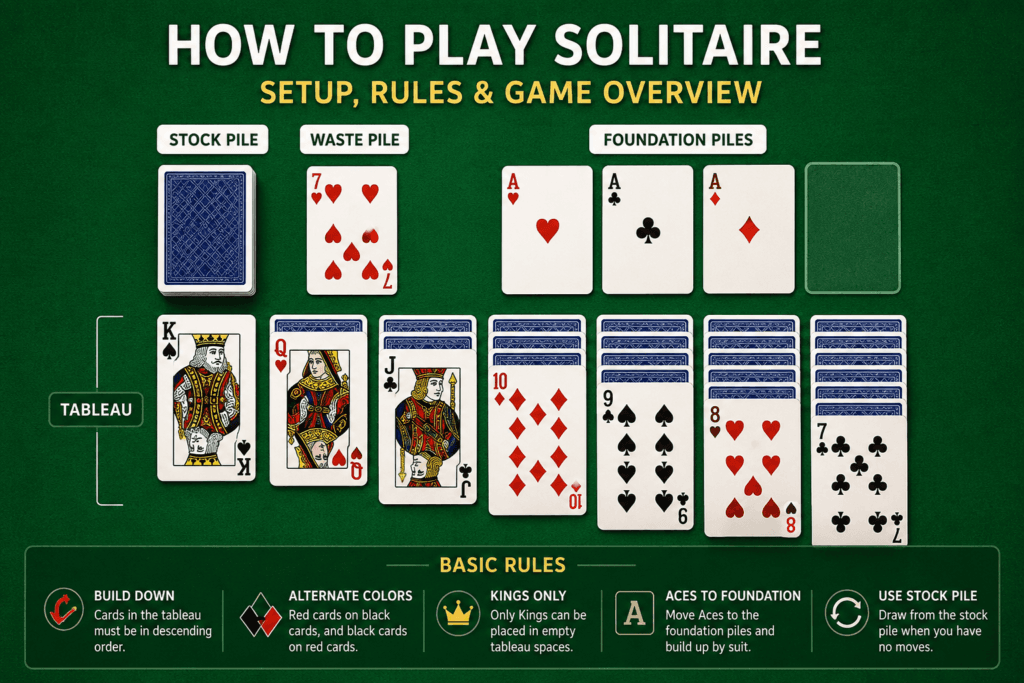
The layout has four main areas:
1. Tableau
This is the main board with seven columns of cards.
The first column has one card, the second column has two cards, the third has three cards, and so on until the seventh column has seven cards.
Only the top card in each column is face up. The rest are face down.
2. Stock Pile
The stock pile is the leftover deck after the tableau is dealt.
You draw from this pile when you need more cards.
3. Waste Pile
Cards drawn from the stock pile go into the waste pile.
Usually, only the top waste card can be played.
4. Foundation Piles
There are four foundation piles, one for each suit: hearts, diamonds, clubs, and spades.
You build these piles from Ace to King.
Main Goal of Solitaire
The goal is simple:
Move every card to the foundation piles in order by suit.
For example, the hearts foundation must be built like this:
Ace of hearts, 2 of hearts, 3 of hearts, and so on up to the King of hearts.
You do the same for diamonds, clubs, and spades.
Basic Solitaire Rules
Solitaire has a few important rules. Once you understand these, the game becomes much easier to follow.
Build tableau columns in descending order
In the tableau, cards are arranged from high to low.
For example, you can place a 6 on a 7, or a Jack on a Queen.
Alternate colors
When moving cards in the tableau, colors must alternate.
That means:
- A red card goes on a black card.
- A black card goes on a red card.
For example, you can place the red 8 of hearts on the black 9 of spades.
You cannot place a red 8 on a red 9.
Only Kings can move to empty spaces
If a tableau column becomes empty, only a King can be placed there.
You can move a single King or a full sequence that starts with a King.
Aces go to the foundation first
Whenever you uncover an Ace, you can move it to the foundation area.
After that, you can build on it with the 2 of the same suit, then the 3, and so on.
Face-down cards must be revealed
When you move a face-up card and uncover a face-down card, flip the hidden card over.
Revealing hidden cards is one of the most important parts of winning solitaire.
How to Play Solitaire Step by Step
Here is a simple way to play if you are just starting.
Step 1: Look for Aces
Check the tableau for any visible Aces.
Move them to the foundation piles right away unless there is a strong reason not to.
Most beginner games start by moving Aces as soon as they appear.
Step 2: Make tableau moves
Look for cards you can stack in descending order while alternating colors.
Example:
You have a black 9 showing, and a red 8 is available. You can move the red 8 onto the black 9.
Step 3: Reveal hidden cards
Try to make moves that uncover face-down cards.
This should usually be your main priority. The more hidden cards you reveal, the more options you create.
Step 4: Use the stock pile
When there are no useful moves in the tableau, draw from the stock pile.
Depending on the version, you may draw one card at a time or three cards at a time.
Draw-one solitaire is easier. Draw-three solitaire is more difficult.
Step 5: Build the foundations
As you reveal cards, move them to the foundation piles in order.
Keep building each suit upward from Ace to King.
Step 6: Keep creating space
Empty tableau columns are valuable because they give you room to move Kings and long card sequences.
Use empty spaces carefully. Do not fill them too quickly unless the move helps reveal more hidden cards or opens up the game.
Simple Solitaire Example
Let’s say you have these visible cards:
- Red 7
- Black 8
- Ace of clubs
- Black Queen
- Red Jack
You can move the red 7 onto the black 8.
You can move the Ace of clubs to the foundation pile.
You can move the red Jack onto the black Queen.
If any of those moves uncover a face-down card, flip that card over.
That is the basic rhythm of solitaire: move, reveal, build, repeat.
Best Solitaire Tips for Beginners
Reveal hidden cards before anything else
A common beginner mistake is moving cards to the foundation too quickly or making moves that look neat but do not reveal anything.
Your first priority should usually be uncovering face-down cards.
More visible cards mean more choices.
Do not rush to empty a column
An empty column is useful only if you have a King to place there.
Before clearing a column, check whether you have a King available. If not, that empty space may sit unused.
Move cards from longer columns first
Longer tableau columns have more hidden cards. Try to work on those columns early.
If you can choose between revealing a card in a short column and revealing one in a long column, the long column is often the better choice.
Be careful with foundation moves
Moving cards to the foundation is the goal, but doing it too early can sometimes block other moves.
For example, a red 5 might be useful in the tableau because a black 4 can sit on it. If you move the red 5 to the foundation too soon, you may lose that option.
A good rule is this: move cards to the foundation when they are clearly no longer needed in the tableau.
Use the undo button to learn
If you are playing digital solitaire, the undo button can be useful for learning.
Do not use it only to fix mistakes. Use it to understand why a move was bad.
Over time, you will start spotting better moves before making them.
Common Solitaire Mistakes
Playing every possible move immediately
Not every legal move is a good move.
Before moving a card, ask: does this reveal a hidden card, open a column, or help build the foundation?
If not, the move may not be necessary.
Filling empty spaces with the wrong King
When you get an empty column, think carefully before placing a King there.
A King with a long sequence under it may be more useful than a single King. The goal is to create movement, not just fill space.
Ignoring the stock pile order
In draw-three solitaire, stock pile order matters a lot.
Sometimes playing one card changes which cards become available later. Pay attention to the order if you are trying to improve.
Moving low cards too early
Small cards like 2s, 3s, and 4s often seem harmless, but they can be important in the tableau.
Do not send every card to the foundation automatically unless it clearly helps.
Draw-One vs Draw-Three Solitaire
There are two common ways to draw from the stock pile.
Draw-One Solitaire
You draw one card at a time.
This version is easier because every stock card becomes available in order.
It is a good choice for beginners.
Draw-Three Solitaire
You draw three cards at a time, but usually only the top card can be played.
This version is harder because some cards may stay buried in the waste pile unless earlier cards are moved.
Draw-three solitaire requires more planning.
Is Every Solitaire Game Winnable?
No. Not every solitaire game can be won.
Some deals are impossible, even with perfect play. That is part of the game.
However, many losses happen because of small mistakes, such as moving cards too quickly, blocking a useful card, or failing to reveal hidden cards early.
Good strategy does not guarantee a win every time, but it improves your chances.
Quick Solitaire Strategy Checklist
Before making a move, check these points:
- Can I reveal a face-down card?
- Can I move an Ace to the foundation?
- Can I open a useful empty column?
- Can I move cards from a long tableau column?
- Am I moving this card too early?
- Will this move create more options or fewer options?
This simple checklist can prevent many bad moves.
Why Solitaire Is Still Popular
Solitaire has stayed popular because it is easy to start and satisfying to improve at.
You do not need another player. You do not need special equipment. A single deck of cards is enough.
Digital solitaire also makes the game quick to play anywhere. You can finish a game in a few minutes, or spend longer trying to solve a difficult deal.
It is simple, quiet, and surprisingly strategic.
Solitaire Quick Guide Summary
Solitaire is a card game where you organize all cards into four foundation piles by suit, from Ace to King.
To play well, focus on revealing hidden cards, building tableau columns in alternating colors, using empty spaces wisely, and moving cards to the foundation at the right time.
The basic rules are easy:
- Build down in the tableau.
- Alternate red and black cards.
- Move Aces to the foundation.
- Build foundations upward by suit.
- Use Kings to fill empty tableau spaces.
- Reveal hidden cards whenever possible.
The more you play, the better you get at spotting strong moves.
Solitaire may look like a simple card game, but every decision matters. That is what makes it worth coming back to.
🔥 Related Posts

Solitaire Jeu Gratuit – The Complete Guide for Canadian Players (2025 Edition)

Forty Thieves Green Felt – The Ultimate Player’s Guide to Winning the Classic Online Solitaire Challenge

FreeCell Green Felt: The Complete Guide to the Classic Card Game

Free Spider Solitaire Online: Best Sites, Tips & How to Play (2025 Guide)

Le Guide Ultime du Solitaire Gratuit en Ligne (France 2025)