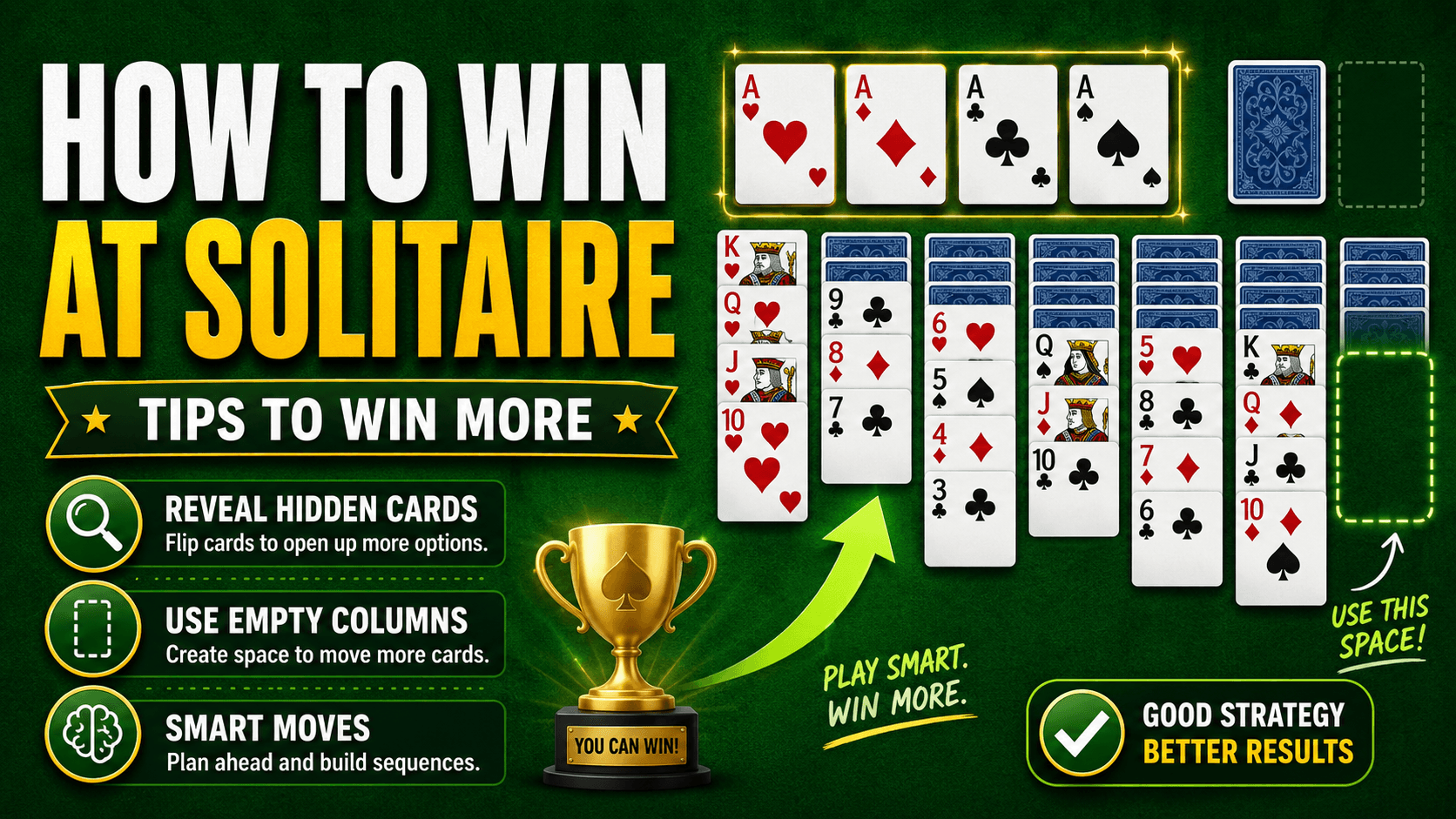
Solitaire looks easy until the game starts closing in on you. One wrong move, one blocked card, one wasted empty space, and suddenly there are no more useful moves left.
The good news is that Solitaire is not just luck. Luck matters because the cards are shuffled, but your choices matter too. If you understand how to reveal hidden cards, manage empty spaces, and avoid rushed moves, you can win more often.
This guide focuses on Klondike Solitaire, the classic version most people know from computers, phones, and card game websites.
First, Understand the Goal
The goal of Solitaire is to move all cards into the four foundation piles.
Each foundation pile is built by suit from Ace to King:
Ace, 2, 3, 4, 5, 6, 7, 8, 9, 10, Jack, Queen, King.
You win when all 52 cards are placed in the foundation piles.
Simple goal. Not always simple to reach.
The main challenge is that many cards start face down. Winning depends on how well you uncover those hidden cards and keep your options open.
The Biggest Rule for Winning: Reveal Hidden Cards
If you remember only one strategy, remember this:
Reveal face-down cards as often as possible.
Hidden cards are the real problem in Solitaire. Every face-down card is a card you cannot use yet. The more cards you uncover, the more possible moves you create.
For example, moving a red 6 onto a black 7 might look useful. But if that move does not reveal a hidden card, it may not be the best move.
Before making any move, ask yourself:
Will this uncover a face-down card?
If yes, it is probably worth considering. If no, look for a stronger move first.
Work on the Longest Tableau Columns First
At the start of a Solitaire game, the right-side columns usually have the most face-down cards. These longer columns are harder to clear, but they are also where many important cards are buried.
When you have a choice between revealing a card in a short column and revealing a card in a long column, the long column is usually the better target.
Why?
Because long columns hide more cards. Clearing them gives you more information and more movement.
This does not mean you should ignore the left side of the board. It means you should not waste too many moves polishing small columns while the big columns stay locked.
Do Not Move Cards Just Because You Can
This is one of the most common beginner mistakes.
In Solitaire, a legal move is not always a good move.
You may be able to move a black 9 onto a red 10, but should you? Maybe. Maybe not.
A good move usually does at least one of these things:
It reveals a hidden card.
It opens an empty column.
It helps move an Ace or low card to the foundation.
It creates a useful sequence.
It gives you access to a card you need.
A weak move only rearranges cards without improving the board.
Try to play with a purpose. Every move should help you get closer to opening the game.
Use Empty Columns Carefully
Empty tableau columns are powerful, but only if you use them properly.
In Klondike Solitaire, only a King can be moved into an empty column. That means an empty space is useful when you have a King ready to move.
Do not rush to create an empty column if you cannot use it.
Also, be careful which King you place there.
A King with a long sequence under it is often better than a single King. For example, moving a King with Queen, Jack, 10, and 9 beneath it can free up more cards and create more movement.
A lonely King may fill the space but do very little.
Move Kings With a Plan
Since only Kings can fill empty tableau spaces, Kings control a lot of the game.
Before placing a King in an empty column, check the board.
Ask:
Which King helps me reveal more cards?
Does this King bring a useful sequence with it?
Will this move block another better King?
Does the color of this King matter for future moves?
For example, if you have a red Queen waiting, a black King may be more useful than a red King. That black King gives the red Queen somewhere to go.
Solitaire is full of small choices like this. The better you get at reading them, the more games you win.
Do Not Send Every Card to the Foundation Too Early
The foundation piles are where the cards need to end up, but moving cards there too quickly can sometimes hurt you.
This sounds strange at first. After all, the goal is to build the foundations.
But cards in the tableau can help you move other cards. If you move them to the foundation too soon, you may remove an important stepping stone.
For example, a red 6 in the tableau might let you move a black 5. If you send that red 6 to the foundation too early, the black 5 may become stuck.
A safe rule is:
Move Aces and 2s to the foundation quickly.
Be more careful with 3s, 4s, 5s, and higher cards.
Do not move a card to the foundation if it is still useful in the tableau.
As the game opens up, foundation moves become safer.
Always Play Aces and Usually Play Twos
Aces should almost always go to the foundation as soon as they appear.
Twos are also usually safe because they do not support many tableau moves. A 2 can only hold an Ace in the tableau, and Aces belong in the foundation anyway.
So in most cases:
Move Aces immediately.
Move 2s when their Ace is already in the foundation.
Think more carefully before moving higher cards.
This simple habit keeps the foundation moving without damaging your tableau options.
Pay Attention to Color Balance
Solitaire is built around alternating colors.
Red cards go on black cards. Black cards go on red cards.
That means color balance matters.
If you move too many cards of one color too quickly, you may create a board where useful cards have nowhere to go.
For example, if you need a black 8 but only red 8s are available, your sequence may get stuck.
When choosing between two similar moves, consider which color will help more later.
A small example:
You have a red 9 and a black 9 available. You also have a black 8 waiting to move.
The red 9 is probably more useful because the black 8 can go on it.
Solitaire is not only about card values. Color matters just as much.
Use the Stock Pile Wisely
The stock pile can save a game, but it can also trick you into lazy play.
Do not keep drawing cards from the stock pile while useful moves are still available on the tableau.
Before drawing, scan the board carefully.
Look for:
Cards that can reveal hidden cards.
Aces that can move to the foundation.
Cards that can be stacked in alternating colors.
Empty spaces that can take a King.
Sequences that can be moved to free a face-down card.
Once you are sure there are no useful tableau moves, then draw from the stock.
Draw-One and Draw-Three Require Different Thinking
In draw-one Solitaire, every stock card becomes available one at a time. This version is easier and more beginner-friendly.
In draw-three Solitaire, only every third card is immediately available unless you play cards from the waste pile. This makes the stock pile much more strategic.
If you are playing draw-three, pay attention to the order of cards in the waste pile. Sometimes playing one card changes which card appears next.
That means you should not always grab the first playable stock card. Sometimes waiting can lead to a better card later.
Draw-three Solitaire rewards memory and planning more than draw-one.
Do Not Break a Useful Sequence Without a Reason
Once you build a good descending sequence, do not split it unless there is a clear benefit.
For example:
Black King
Red Queen
Black Jack
Red 10
Black 9
This is a strong sequence. It gives you structure and movement.
Breaking it apart just to make a small move somewhere else may weaken your board.
However, if splitting a sequence reveals a hidden card or opens an important column, it may be worth it.
Again, the question is not “Can I move this card?”
The question is “Does this move improve the game?”
Try to Keep Options Open
Winning Solitaire is often about keeping the board flexible.
Avoid moves that lock cards in place unless they create a clear advantage.
A flexible board has:
Open tableau spaces.
Several playable columns.
Foundation piles moving evenly.
Cards available in both colors.
Kings placed with useful sequences.
Fewer buried face-down cards.
A blocked board has:
No empty spaces.
Long columns with hidden cards.
Waste pile cards that cannot move.
Foundation piles that are uneven.
Cards stacked in ways that trap lower cards.
The more flexible your board, the better your chances.
Build Foundations Evenly When Possible
Try not to push one foundation pile far ahead while others are stuck near the bottom.
For example, if hearts are built up to 9 but clubs and spades are still on 2, your tableau may become awkward. You might need lower black cards to move red cards, but those cards could still be buried.
Even foundation building gives you more balanced movement.
This does not mean every suit must stay exactly even. It means you should avoid rushing one suit too far unless you are sure it is safe.
Use the Undo Button as a Learning Tool
If you are playing digital Solitaire, the undo button can help you improve.
Do not use it only to reverse bad luck. Use it to study your choices.
When a move leads to a dead end, undo it and ask:
What did that move block?
Did I move a card to the foundation too early?
Did I fill an empty column with the wrong King?
Did I ignore a better move in a longer column?
Did I draw from the stock too soon?
This is one of the fastest ways to get better.
Common Mistakes That Stop You From Winning
Many Solitaire losses happen because of simple mistakes. Here are the big ones.
Moving too fast
Fast play feels good, but it causes errors. Take a few seconds to scan the board before each move.
Filling empty columns too quickly
An empty column is valuable. Do not waste it on a King that does not help.
Ignoring face-down cards
If you are not revealing hidden cards, you are probably not improving the board.
Moving cards to the foundation too early
Foundation moves are good when they are safe. They are bad when they remove cards you still need.
Playing from the stock pile too often
The tableau should usually come first. Use the stock pile when the board has no strong moves.
Forgetting about color
A card’s color decides where it can move. Always think about red and black options.
Best Opening Strategy for Solitaire
At the beginning of the game, focus on opening the tableau.
Here is a strong opening approach:
Move any visible Aces to the foundation.
Move 2s when possible.
Look for moves that reveal face-down cards.
Prioritize longer columns.
Do not draw from the stock pile until you have checked the tableau.
Create an empty column only when a useful King is available.
The early game sets the tone. If you reveal several hidden cards quickly, the rest of the game becomes much easier.
Middle Game Strategy
The middle of a Solitaire game is where most decisions matter.
At this point, you should be managing several goals at once.
You want to keep revealing cards.
You want to build the foundations.
You want to create empty spaces.
You want to avoid blocking useful cards.
You want to use the stock pile carefully.
This is where patience helps.
Before making a move, look at what it makes possible. A move that looks small may open a column. A move that looks obvious may block the only card you need.
Endgame Strategy
The endgame begins when most of the tableau is visible and the foundations are moving steadily.
At this stage, you can usually be more aggressive with foundation moves.
Once there are few hidden cards left, tableau cards are less needed as stepping stones. Start moving cards to the foundation more freely.
Still, check for traps. Sometimes one buried card can stop the whole game.
If all cards are visible, the game is usually much easier to finish. You just need to move cards in the right order.
Is Solitaire Mostly Luck or Skill?
Solitaire is both luck and skill.
Some games cannot be won because of the way the cards are dealt. That is part of the game.
But many games are lost because of poor choices. Moving too quickly, wasting empty columns, and ignoring hidden cards can turn a winnable game into a loss.
Good strategy will not make every game winnable, but it will help you win more often.
Quick Checklist Before Every Move
Use this simple checklist while playing:
Will this reveal a hidden card?
Will this open a useful empty column?
Do I have a King ready for an empty space?
Am I moving this card to the foundation too early?
Does this move help my next move?
Am I keeping red and black options open?
Is there a better move in a longer column?
This small pause can prevent most beginner mistakes.
Final Thoughts: How to Win at Solitaire More Often
To win at Solitaire, focus less on speed and more on control.
Reveal hidden cards early. Work on long columns. Use empty spaces carefully. Move Aces and low cards to the foundation, but do not rush every card upward. Think about color, card order, and future moves.
Solitaire is not about making every move you see. It is about making the move that gives you the most options next.
The more you practice this way, the more often you will turn difficult games into wins.
🔥 Related Posts

Solitaire Quiz – Test Your Knowledge & Improve Your Card Game Skills (2025 Guide)
Solitaire Quick Guide: Learn the Basics, Make Better Moves, and Win More Games

MSN Games Free Online Games: Best Classic Browser Games to Play in 2025

Microsoft Solitaire Collection – Full Guide, Tips & How to Play

Pyramid Solitaire – Complete Guide, Rules, Strategy, Tips & Online Play