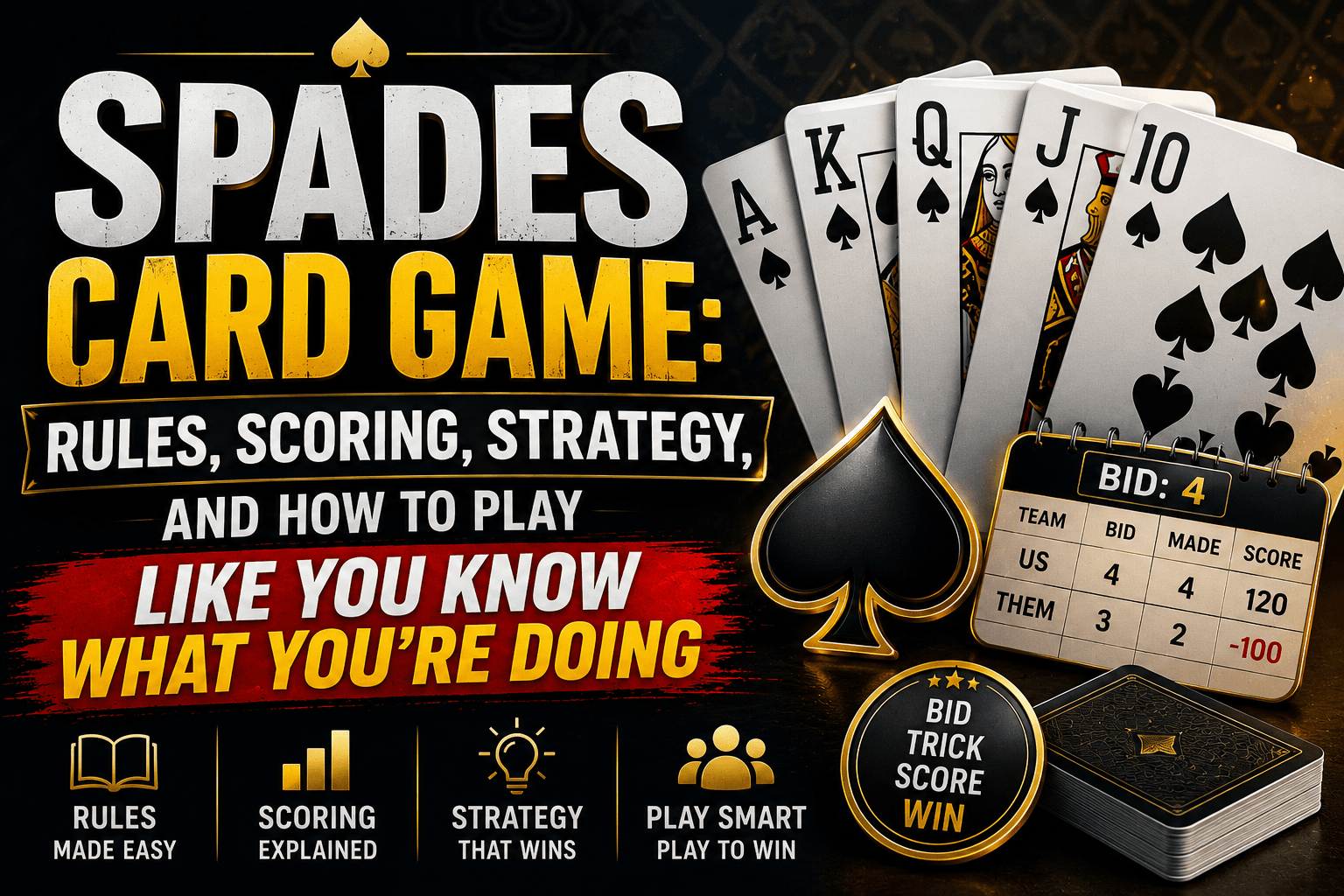
The Spades card game is one of those classic games that never really disappears. It is easy enough for beginners to learn in one sitting, but strategic enough to keep experienced players arguing over bids, bags, nil calls, and risky plays for years. You can play it at home, at family gatherings, in college dorms, online, or on a mobile app. The rules are simple on the surface, but the decisions can get sharp very quickly.
Spades is a trick-taking card game usually played with four players in two partnerships. Partners sit across from each other, and the goal is to predict how many tricks your team can win. The twist is that spades are always trump. That means a spade can beat cards from other suits when a player cannot follow suit. This one rule gives the game its name and its personality.
What makes Spades so enjoyable is the balance between skill and risk. You need to read your hand, trust your partner, count cards, watch what opponents play, and decide when to take control or stay quiet. A bad bid can hurt more than a bad card. A smart nil bid can change the entire game. One extra trick can become a sandbag, and too many bags can cost your team 100 points.
This complete guide explains how to play Spades, how scoring works, how bidding works, what nil means, what bags are, and how beginners can start playing better without memorizing complicated theory.
Quick Answer: What Is the Spades Card Game?
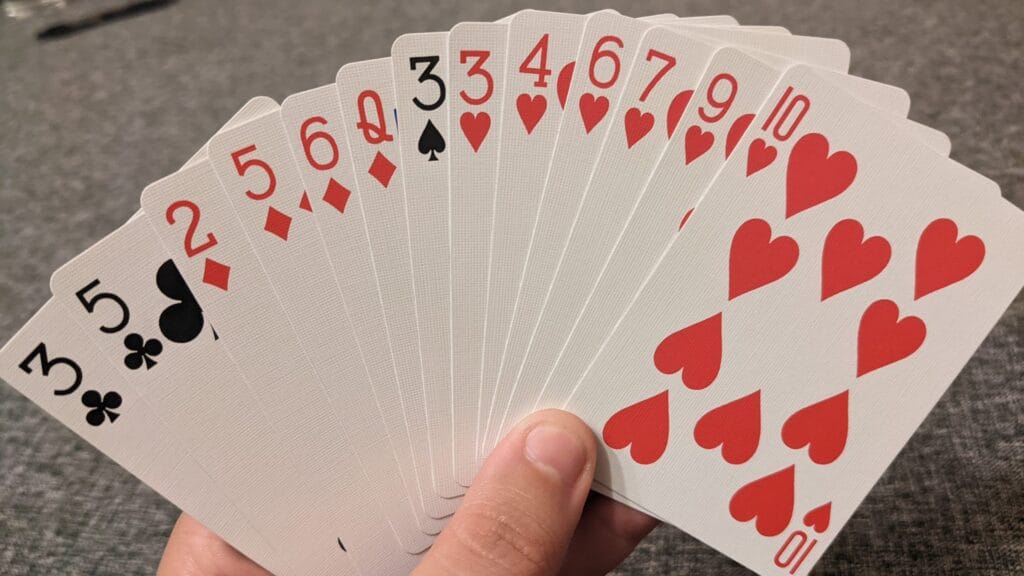
Spades is a trick-taking card game where players bid how many tricks they expect to win. It is usually played by four players in two teams. A standard 52-card deck is used, and spades are always the trump suit. Teams earn points by meeting their combined bid and lose points when they fail. The game is commonly played to 500 points.
In simple words, Spades is about making a promise before the hand starts, then trying to keep that promise.
Spades Card Game Overview
| Game Detail | Standard Spades Setup |
|---|---|
| Players | 4 players, usually 2 teams |
| Deck | Standard 52-card deck |
| Cards dealt | 13 cards to each player |
| Trump suit | Spades |
| Game type | Trick-taking |
| Common winning score | 500 points |
| Main skill | Bidding, counting cards, teamwork |
| Best for | Teens, adults, families, card game fans |
| Average round length | 5–10 minutes per hand |
| Difficulty | Easy to learn, medium to master |
Spades is popular because it does not require special equipment. One deck of cards is enough. It also moves faster than some other trick-taking games, which makes it good for casual play and competitive play.
Basic Terms You Should Know Before Playing Spades
Before learning the rules, it helps to understand the main words used in the game. Spades players use these terms constantly.
| Term | Meaning |
| Trick | One round where each player plays one card |
| Bid | The number of tricks a player says they will win |
| Trump | A suit that can beat other suits; in Spades, spades are always trump |
| Lead | The first card played in a trick |
| Follow suit | Playing a card from the same suit as the lead card |
| Nil | A bid of zero tricks |
| Bag / Sandbag | An extra trick won above the team’s bid |
| Set | Failing to make your bid |
| Blind nil | Bidding nil before looking at your cards |
| Partnership | Two players working as a team |
| Book | Another word for trick, often used in casual Spades games |
Once you understand these terms, the game becomes much easier to follow.
How to Set Up the Spades Card Game
A standard game of Spades uses four players and one 52-card deck. Players sit around a table, and partners sit across from each other. If you are playing with names, Team A may be North and South, while Team B may be East and West.
The dealer shuffles the cards and deals all 52 cards one at a time. Each player receives 13 cards. After the deal, players look at their hands and decide how many tricks they think they can win.
There are no leftover cards in standard four-player Spades. Every card is in play, which means card counting becomes useful as the hand progresses.
Card Ranking in Spades
Cards rank from highest to lowest in the usual order.
| Rank | Card |
| Highest | Ace |
| 2nd | King |
| 3rd | Queen |
| 4th | Jack |
| Then | 10, 9, 8, 7, 6, 5, 4, 3 |
| Lowest | 2 |
The suit of spades is always trump. That means even a low spade can beat high cards from hearts, diamonds, or clubs if spades are allowed in that trick.
For example, if hearts are led and someone plays the Ace of Hearts, a player who has no hearts can play the 2 of Spades. The 2 of Spades beats the Ace of Hearts because spades are trump.
That rule is the heart of the game.
How to Play Spades: Step-by-Step Rules
Spades is played in hands. Each hand has three main parts: dealing, bidding, and playing tricks. After all 13 tricks are played, teams score points based on their bids and results.
Step 1: Deal the Cards
The dealer shuffles the deck and deals 13 cards to each player. In a four-player game, all cards are used.
Players should organize their cards by suit. Many people sort their hands as spades, hearts, diamonds, and clubs. This makes it easier to count suits and plan bids.
Step 2: Bid Your Tricks
After looking at their cards, each player bids the number of tricks they expect to win. Partners’ bids are added together to create a team bid.
For example:
| Player | Bid |
| Player 1 | 3 |
| Player 2 | 4 |
| Team Bid | 7 |
This team must win at least 7 tricks to make its bid.
A player can also bid nil, which means they promise to win zero tricks. Nil is risky but valuable. If successful, it usually earns a big bonus. If it fails, it usually costs points.
Step 3: Start the First Trick
The player to the dealer’s left usually leads the first trick. That player places one card face up. The suit of that card is the suit that others must follow if they can.
For example, if the first player leads with the 9 of Clubs, every other player must play a club if they have one.
Step 4: Follow Suit
Each player must follow the suit that was led if possible. If a player does not have that suit, they may play any card, including a spade.
The highest card in the led suit wins the trick unless a spade is played. If one or more spades are played, the highest spade wins the trick.
Step 5: Winner Leads the Next Trick
The player who wins the trick collects the four cards and leads the next trick. This continues until all 13 tricks have been played.
Step 6: Count Tricks and Score the Hand
At the end of the hand, each team counts how many tricks it won. Then the score is calculated based on the team’s bid, extra tricks, nil bids, and possible bag penalties.
Important Rule: When Can Spades Be Played?
In many common Spades rules, spades cannot be led until spades are “broken.” Spades are broken when a player uses a spade because they cannot follow the suit that was led.
For example, if hearts are led and you have no hearts, you may play a spade. After that happens, spades are considered broken. From then on, a player may lead with spades.
Some casual tables use different house rules. At some tables, players allow spades to be led at any time. Before starting, it is smart to agree on this rule.
| Rule Version | Meaning |
| Spades must be broken | You cannot lead spades until someone plays a spade on another suit |
| Spades may be led anytime | Players can lead spades whenever they want |
| House rule | The table decides before play begins |
For beginners, “spades must be broken” is the most common and balanced way to play.
Spades Scoring Explained
Scoring is where Spades becomes more strategic. Your team does not simply score for every trick. You score based on whether you made your bid.
The most common scoring system works like this:
| Result | Score |
| Team makes its bid | 10 points per trick bid |
| Extra tricks above bid | 1 point each, called bags |
| Team fails its bid | Minus 10 points per trick bid |
| Successful nil | Usually +100 points |
| Failed nil | Usually -100 points |
| 10 bags | Usually -100 point penalty |
Basic Scoring Example
If your team bids 6 and wins exactly 6 tricks, you score 60 points.
If your team bids 6 and wins 8 tricks, you score 62 points. That is 60 points for the bid and 2 extra points for the two bags.
If your team bids 6 and wins only 5 tricks, you are set. Your team loses 60 points.
| Team Bid | Tricks Won | Score |
| 6 | 6 | +60 |
| 6 | 7 | +61 |
| 6 | 8 | +62 |
| 6 | 5 | -60 |
| 7 | 9 | +72 |
| 7 | 6 | -70 |
The key lesson is simple: making your bid matters more than taking every trick.
What Are Bags in Spades?
Bags, also called sandbags, are extra tricks taken above your bid. If your team bids 5 and wins 7 tricks, you earned 2 bags.
At first, bags look harmless because they add 1 point each. But they become dangerous. In many games, when a team reaches 10 bags, it receives a 100-point penalty.
Example:
| Hand | Bid | Tricks Won | Bags This Hand | Total Bags |
| 1 | 6 | 7 | 1 | 1 |
| 2 | 5 | 7 | 2 | 3 |
| 3 | 4 | 6 | 2 | 5 |
| 4 | 7 | 9 | 2 | 7 |
| 5 | 5 | 8 | 3 | 10 |
When the team reaches 10 bags, the score is usually reduced by 100 points, and the bag count resets.
Bags are one of the reasons Spades is more than a trick-taking race. You do not always want every trick. Sometimes you want opponents to take unwanted tricks so they collect bags instead.
What Is Nil in Spades?
Nil is a special bid where a player says they will take zero tricks. If the player succeeds, the team usually earns 100 bonus points. If the player takes even one trick, the nil fails and the team usually loses 100 points.
Nil is exciting because it can change the score quickly. A team that is behind can catch up with a successful nil. A team that fails nil can fall badly behind.
Nil Example
| Bid Type | Result | Score Impact |
| Nil succeeds | Player takes 0 tricks | +100 |
| Nil fails | Player takes 1 or more tricks | -100 |
When one player bids nil, the partner has an important job. The partner often tries to “cover” the nil bidder by winning tricks that might otherwise force the nil bidder to take one.
For example, if your partner bid nil and is forced to play the King of Clubs, you may need to win the trick with the Ace of Clubs or a spade if possible.
When Should You Bid Nil?
Nil is tempting, but it should not be used carelessly. A good nil hand usually has low cards, short suits, and few dangerous middle cards.
A strong nil hand may look like this:
• Several low cards
• Few or no spades
• No aces
• No kings
• Short suits that let your partner cover you
• Low cards in most suits
A dangerous nil hand may include:
• Ace, King, or Queen in any suit
• Several middle cards like 8, 9, 10, or Jack
• Too many spades
• Long suits where you may be forced to win
• No clear way for your partner to protect you
Nil is not only about having low cards. It is also about timing, table position, and your partner’s bid. If your partner has a strong hand, nil becomes safer. If your partner also has a weak hand, nil can become risky.
Blind Nil in Spades
Blind nil is a more extreme version of nil. A player bids nil before looking at their cards. Because it is much riskier, blind nil usually has a bigger reward and a bigger penalty. Many tables score blind nil as +200 if successful and -200 if failed.
Some groups only allow blind nil when a team is far behind. This keeps the game balanced and prevents players from using it too casually.
| Bid | When It Happens | Common Score |
| Nil | After seeing cards | +100 or -100 |
| Blind nil | Before seeing cards | +200 or -200 |
Blind nil is a comeback tool. It is risky, dramatic, and sometimes exactly what a losing team needs.
Beginner Bidding Guide for Spades
Bidding is the most important part of Spades. A strong player can win with average cards by bidding wisely. A weak player can lose with strong cards by overbidding or underbidding.
When you look at your hand, start by counting likely winners.
Strong cards include:
• Aces
• Kings protected by lower cards
• High spades
• Short suits where you can use spades later
• Long suits with multiple top cards
Risky cards include:
• Unprotected kings
• Queens in short suits
• Low spades that may become forced winners
• Middle cards that are hard to control
• High cards in suits where opponents may be void
Here is a simple bidding guide for beginners.
| Card Situation | Possible Bid Value |
| Ace in a non-spade suit | Often 1 trick |
| King with support cards | Often 1 trick |
| Ace of Spades | Almost always 1 trick |
| King of Spades | Usually 1 trick |
| Queen of Spades | Sometimes 1 trick |
| Low spades | May win later, but not guaranteed |
| Short suit with spades | Possible trump tricks |
| Long weak suit | Usually not many winners |
Do not count every high card as a guaranteed trick. Spades can cut non-spade aces and kings if someone is void in that suit. Also, your partner may need tricks too, so bidding should be realistic.
How to Play a Spades Hand Well
After bidding, your goal is to make your team bid without taking too many bags. That means every card matters.
If your team has a high bid, you need to win enough tricks early enough to stay safe. If your team has a low bid, you may need to avoid unwanted tricks. If your partner bids nil, your priority may shift to protecting them.
Good Spades play usually involves three habits.
First, follow suit carefully. If you have the led suit, you must play it. But you can choose whether to play high or low. Sometimes you play low to save power. Sometimes you play high to take control.
Second, count spades. Since spades are trump, knowing which spades are still out can help you decide when to attack.
Third, watch your partner. Spades is a partnership game. Your partner’s cards and choices matter as much as your own.
Basic Spades Strategy for Beginners
A beginner can improve quickly by following a few simple strategy rules.
1. Do Not Overbid Too Often
New players often look at a hand full of face cards and bid too high. That is dangerous. High cards are not guaranteed winners, especially if opponents can trump them with spades.
A safer bid is usually better than an ambitious bid. Getting set is expensive.
2. Protect Your Partner’s Nil
If your partner bids nil, your job changes. You may need to win tricks you normally would avoid. Watch the cards your partner plays. If they play a dangerous high card, try to cover it.
3. Do Not Waste High Spades Too Early
The Ace of Spades and King of Spades are powerful. Use them with purpose. If you play them too early, you may lose control later.
4. Count Bags
Do not forget the bag count. If your team already has 8 or 9 bags, taking extra tricks can be costly. Sometimes you should let opponents win tricks to avoid crossing the 10-bag penalty.
5. Pay Attention to Voids
A player is void when they have no cards left in a suit. If an opponent is void in clubs, they may be able to trump your club winners with spades. Notice when players stop following a suit.
6. Communicate Through Play
In most Spades games, table talk about your cards is not allowed. But you can communicate through legal card play. Leading a suit, playing low, or taking a trick can give your partner useful information.
Advanced Spades Strategy
Once you know the basic rules, the game becomes more about control. Advanced players do not just ask, “Can I win this trick?” They ask, “Should I win this trick?”
Bagging the Opponents
If opponents already have many bags, you can sometimes force them to take extra tricks. This is called bagging. It is a powerful strategy because a 100-point bag penalty can swing the game.
Setting the Opponents
To set a team, you stop them from making their bid. If opponents bid 8, they must win at least 8 tricks. If you can hold them to 7, they lose 80 points.
Setting is often better than safely making your own bid, but it requires careful judgment. Do not chase a set if it causes your team to fail too.
Managing Trump Control
High spades control the game late in the hand. If you have strong spades, you may want to save them until opponents are weak. If opponents have strong spades, you may want to draw them out earlier.
Reading the Table
Every card played gives information. If someone plays a low card under pressure, they may be weak in that suit. If someone throws off instead of following suit, they are void. If a player refuses to take a trick they could win, they may be avoiding bags or protecting nil.
Good players remember these clues.
Common Spades Mistakes
Many Spades mistakes come from playing too fast. The rules are easy, but the decisions deserve attention.
| Mistake | Why It Hurts |
| Overbidding | Getting set costs big points |
| Ignoring bags | 10 bags can cause a 100-point penalty |
| Forgetting partner’s bid | Spades is a team game |
| Playing high cards too early | You may lose control later |
| Not watching suits | You miss voids and trump chances |
| Bidding nil with dangerous cards | One forced trick ruins the nil |
| Taking every trick possible | Extra tricks can become bags |
| Not agreeing on house rules | Arguments start mid-game |
The fastest way to improve is to stop treating every trick as something you must win. In Spades, winning the wrong trick can be a mistake.
Spades Variations
Spades has many house rules and variations. This is part of why the game stays popular. Different families, friend groups, and online platforms may use slightly different rules.
| Variation | How It Works |
| Solo Spades | Each player plays for themselves |
| Partnership Spades | Four players play in two teams |
| Spades with Jokers | Jokers are added as high trump cards |
| Suicide Spades | One player on each team must bid nil |
| Mirror Spades | Players bid based on number of spades in hand |
| Whiz Spades | Players must bid nil or bid their number of spades |
| Blind Nil | Player bids nil before seeing cards |
| No Bags | Extra tricks do not create bag penalties |
| 10-for-200 | Bidding and making 10 tricks earns bonus points |
Before playing, agree on the rules. This is especially important for nil, blind nil, jokers, bags, and when spades can be led.
Spades With Jokers
Some people play Spades with jokers. In this version, one or two jokers are added to the deck and usually become the highest trump cards. The Big Joker may rank above the Little Joker, and both may rank above the Ace of Spades.
A common joker ranking looks like this:
| Rank | Trump Card |
| Highest | Big Joker |
| 2nd | Little Joker |
| 3rd | Ace of Spades |
| 4th | King of Spades |
| 5th | Queen of Spades |
Spades with jokers is more explosive because trump power increases. Bidding also changes because players with jokers have more reliable winners.
Online Spades vs. Playing at the Table
Online Spades has become popular because it is fast and convenient. You can play against bots, friends, or real opponents without needing four people in the same room.
Online Spades is useful for beginners because the software handles dealing, legal moves, and scoring. That makes it easier to learn the flow of the game.
However, table Spades has its own appeal. You can read body language, enjoy conversation, and experience the social side of the game. Many players learn Spades from family or friends, which gives the game a personal feeling.
| Online Spades | Table Spades |
| Easy to start anytime | More social |
| Automatic scoring | Better for house rules |
| Good for practice | More personal and interactive |
| Can play bots or strangers | Requires real players |
| Faster pace | More table talk and personality |
Both versions are useful. If you are new, online Spades can help you practice. If you want the full social experience, play with people in person.
Is Spades Hard to Learn?
Spades is not hard to learn, but it takes time to play well. Most beginners can understand the basic rules after one or two hands. The harder part is learning when to bid high, when to bid low, when to protect nil, when to take bags, and when to set opponents.
The game is easy at the rule level and deeper at the strategy level. That is one reason it has stayed popular for so long.
Spades Card Game Etiquette
Spades can become competitive, but good etiquette keeps the game enjoyable.
Basic Spades etiquette includes:
• Do not reveal your cards during play.
• Do not tell your partner what to play.
• Do not complain after every trick.
• Agree on house rules before the game starts.
• Play at a reasonable pace.
• Keep score clearly.
• Respect beginners.
• Do not quit just because your team is losing.
A good Spades table is competitive but fair. The best games have tension, laughter, and a little bit of friendly frustration.
Best Tips for Winning More Spades Games
If you want to win more often, focus on better decisions rather than lucky hands.
Here are practical winning tips:
• Bid honestly, not emotionally.
• Count high spades as strong winners.
• Be careful with unprotected kings and queens.
• Watch which suits players run out of.
• Protect your partner’s nil when needed.
• Avoid extra bags when your team is close to 10.
• Try to set opponents when their bid looks too high.
• Save trump cards for important tricks.
• Learn your partner’s playing style.
• Keep track of the score before bidding.
The score affects strategy. A team that is far behind may need a risky nil or blind nil. A team that is ahead may need safer bids and bag control.
Spades Card Game Example Hand
Imagine your hand looks like this:
| Suit | Cards |
| Spades | A, Q, 8, 3 |
| Hearts | K, 9, 4 |
| Diamonds | A, 10, 6 |
| Clubs | Q, 7, 2 |
This is a solid hand. You probably have the Ace of Spades as a sure trick. The Ace of Diamonds is likely a trick unless someone trumps it. The King of Hearts might win if the Ace is gone or if hearts behave well. The Queen of Spades may also win depending on how spades are played.
A beginner might bid 5. A cautious player might bid 4. The right bid depends on your partner’s bid, the score, and table style.
This is why Spades is interesting. The cards matter, but judgment matters more.
Spades Scoring Cheat Sheet
Use this quick scoring table when learning.
| Situation | Points |
| Bid 4, win 4 | +40 |
| Bid 4, win 5 | +41 and 1 bag |
| Bid 4, win 6 | +42 and 2 bags |
| Bid 4, win 3 | -40 |
| Bid 6, win 8 | +62 and 2 bags |
| Bid 7, win 6 | -70 |
| Successful nil | +100 |
| Failed nil | -100 |
| 10 accumulated bags | -100 |
This cheat sheet covers the most common scoring style. Always check house rules before playing.
Frequently Asked Questions About the Spades Card Game
What is the Spades card game?
Spades is a trick-taking card game where players bid how many tricks they expect to win. It is usually played by four players in two teams. Spades are always trump, and the goal is to score points by making your bid.
How many cards do you get in Spades?
In a standard four-player game, each player gets 13 cards. The full 52-card deck is dealt.
Are spades always trump?
Yes. In the standard Spades card game, spades are always the trump suit.
Can you play Spades with two players?
Yes, there are two-player Spades variations, but the standard version is played with four players in two partnerships.
What does nil mean in Spades?
Nil means a player bids zero tricks. If the player wins no tricks, the team usually earns 100 points. If the player takes one or more tricks, the team usually loses 100 points.
What are bags in Spades?
Bags are extra tricks taken above the team’s bid. For example, if a team bids 5 and wins 7 tricks, it gets 2 bags. In many games, 10 bags cause a 100-point penalty.
What score wins in Spades?
A common winning score is 500 points. Some casual games use 300 points or another target.
Can you lead with spades at the start?
In many common rules, you cannot lead with spades until spades are broken. Spades are broken when someone plays a spade because they cannot follow the suit that was led. Some tables use different house rules.
Is Spades a game of luck or skill?
Spades includes luck because the cards are dealt randomly, but skill matters a lot. Bidding, card counting, partner awareness, nil defense, and bag control can strongly affect the outcome.
What is the best beginner strategy for Spades?
The best beginner strategy is to bid carefully, avoid overbidding, count spades, protect your partner’s nil, and pay attention to bags. Do not try to win every trick unless your bid requires it.
Final Thoughts: Why Spades Is Worth Learning
The Spades card game is simple enough for a new player and strategic enough for serious card players. It rewards memory, patience, teamwork, and nerve. You need to know when to win, when to lose, when to protect your partner, and when to pressure your opponents.
That is what makes Spades different from many casual card games. It is not just about having good cards. It is about making the right bid and then playing the hand with discipline.
If you are learning Spades for the first time, start with the basic rules. Play a few hands without worrying too much about advanced strategy. Once you understand bidding, tricks, trump, nil, and bags, the deeper parts of the game will start to make sense.
A deck of cards is all you need. Four players make it better. A smart partner makes it dangerous.
🔥 Related Posts
MSN Sudoku Daily Puzzle Error – Causes, Solutions, Pros & Cons

The Best Cross-Platform Mobile Games You Can Play on PC & Console

Subnautica 2 Release Date: Everything You Need to Know About the Early Access Launch

Arc Raiders Map Guide 2026: All Maps, Interactive Tools, Loot Spots & Pro Tips

Soccer Physics – The Ultimate Guide for 2025 (How to Play, Tips, Tricks & Full Breakdown)