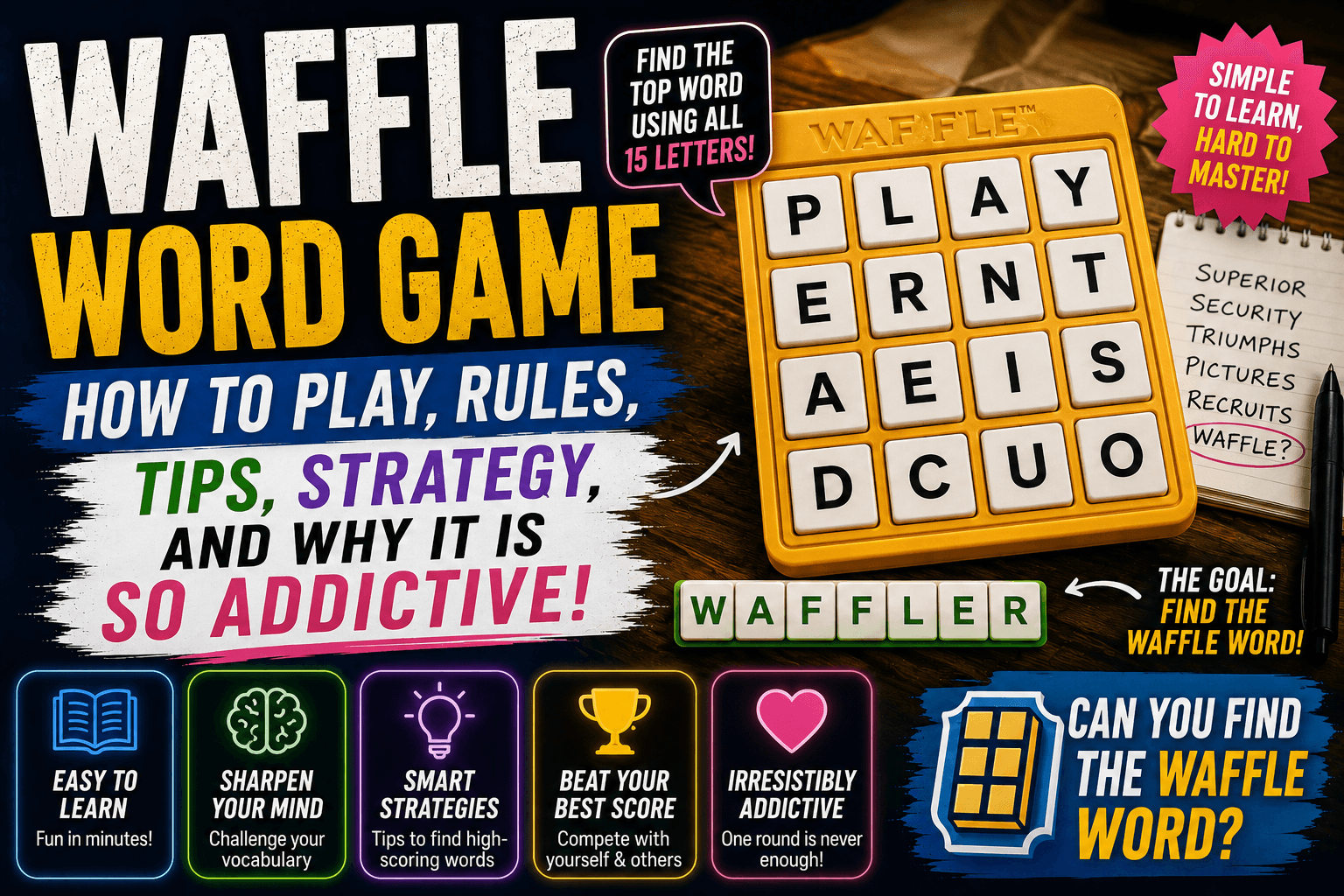
The Waffle word game is a daily word puzzle where players rearrange scrambled letters on a waffle-shaped grid to form correct words across and down. It looks simple at first, but once you start playing, you quickly realize it is more than another Wordle-style game.
Instead of guessing a hidden word from scratch, Waffle gives you all the letters on the board. Your job is to move those letters into the right positions. That small twist makes the game feel like a mix of Wordle, crossword solving, anagram puzzles, and logic games.
The goal is not only to solve the puzzle. The real challenge is solving it efficiently.
You get a limited number of swaps. Every wrong or careless swap can cost you a better score. That is why Waffle feels calm, clever, and stressful at the same time. You can see the letters. You can see the grid. You know the answer is right there. But finding the cleanest path takes patience.
For word-game fans, that is exactly what makes Waffle addictive.
Quick Answer: How Do You Play Waffle?
In the Waffle word game, you swap letters around the board until all the words across and down are correct. The colors help you understand where each letter belongs. Green means the letter is already in the right place. Yellow means the letter belongs in that word but is in the wrong position. Gray or dark letters usually mean the letter does not belong in that spot or word.
You have 15 swaps to solve the puzzle. A perfect solution usually means solving it in the fewest possible swaps and keeping the highest number of stars.
In simple words:
Waffle is a daily word puzzle where you rearrange letters instead of typing guesses.
Waffle Word Game Overview
| Feature | Details |
|---|---|
| Game Type | Daily word puzzle |
| Main Goal | Rearrange letters to form correct words |
| Puzzle Shape | Waffle-style grid |
| Words to Solve | Across and down words |
| Main Action | Swap letters |
| Move Limit | 15 swaps |
| Scoring Style | Remaining swaps become stars |
| Best For | Wordle fans, crossword fans, puzzle lovers |
| Difficulty | Easy to learn, tricky to master |
| Main Skill | Word logic, letter placement, swap planning |
Why Waffle Became Popular
Waffle became popular because it gives word-game players something familiar but different.
Wordle asks you to guess one hidden word. Crosswords ask you to solve clues. Anagram games ask you to rearrange letters. Waffle combines parts of all three, but it removes the pressure of guessing random words from nothing.
You already have the letters. That makes the game feel fair.
But fair does not mean easy.
The pressure comes from efficiency. You can solve the puzzle with messy swaps, but if you want a strong score, you need to think ahead. Every move should fix something. The best players do not just swap letters because they see a match. They study the whole grid first.
That is why Waffle works so well as a daily habit. It is short enough to play with coffee, but clever enough to make your brain feel awake.
Waffle vs Wordle: What Is the Difference?
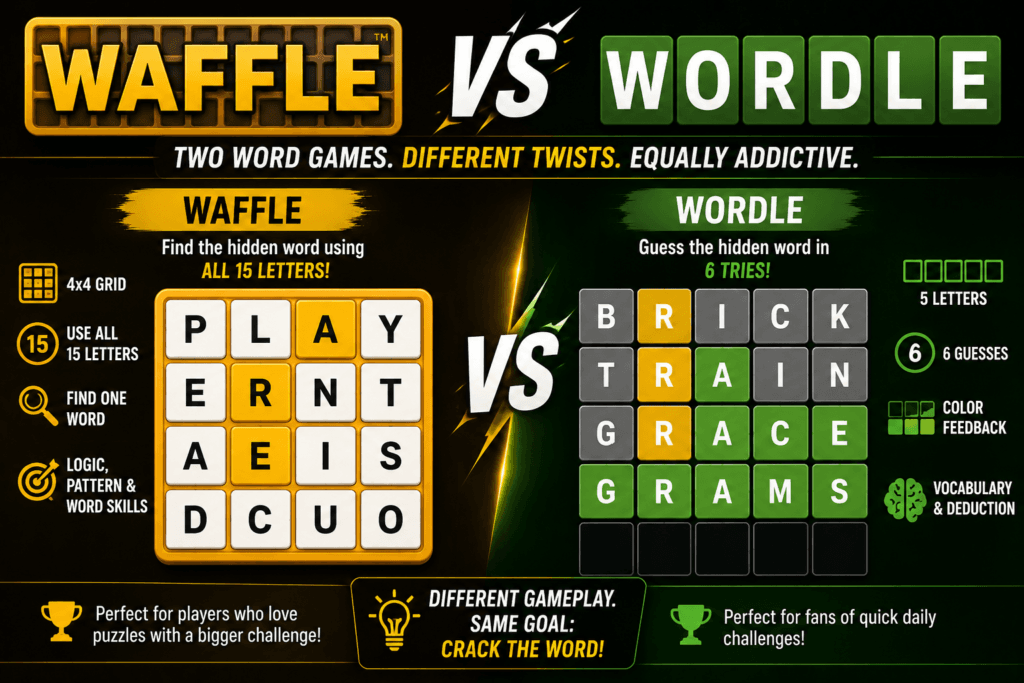
Waffle is often compared to Wordle because both are daily word games with color clues. But the actual gameplay is very different.
| Feature | Waffle Word Game | Wordle |
| Main Goal | Rearrange letters into multiple words | Guess one hidden word |
| Player Action | Swap letters | Type guesses |
| Clue System | Color-coded letter positions | Color-coded letter feedback |
| Number of Words | Multiple connected words | One word |
| Main Challenge | Efficient letter placement | Smart word guessing |
| Guessing Required? | Less guessing, more rearranging | More guessing and deduction |
| Score Pressure | Limited swaps and stars | Limited attempts |
| Best Skill | Pattern recognition and swap planning | Vocabulary and deduction |
If Wordle feels too dependent on finding the right starting word, Waffle may feel more strategic. You are not searching in the dark. You are untangling a grid.
How the Waffle Grid Works
The Waffle board is built from connected words. Some letters belong to horizontal words, some belong to vertical words, and some are shared by both. These shared letters are important because moving one letter can affect two words at the same time.
That is where the real puzzle begins.
A letter might look useful in one word, but if it sits at an intersection, it must also work in the crossing word. Good Waffle players pay close attention to these crossing points because they can confirm or eliminate possible placements quickly.
Basic Grid Logic
| Grid Area | Why It Matters |
| Green letters | Already correct, usually should not be moved |
| Yellow letters | Belong in the word but need a new position |
| Gray/dark letters | Likely wrong for that word or position |
| Corner letters | Often easier to place because they affect fewer words |
| Center/intersection letters | More important because they affect both across and down words |
| Long word rows/columns | Give more context for letter patterns |
The more you understand the grid, the fewer wasted swaps you make.
What Do the Waffle Colors Mean?
The color system is the heart of the Waffle word game. It guides you toward the correct answer without giving everything away.
| Color | Meaning | What You Should Do |
| Green | The letter is in the correct position | Usually leave it alone |
| Yellow | The letter belongs in that word but not in that position | Move it somewhere else in the same word |
| Gray/Dark | The letter does not belong in that position or word | Use it elsewhere |
| Completed Word | All letters are correct | Avoid changing it unless you made a mistake |
The biggest beginner mistake is moving green letters too early. Unless you are absolutely sure it is part of a necessary swap strategy, green letters should usually stay where they are.
How Scoring Works in Waffle
Waffle rewards efficient solving. You get a limited number of swaps, and the swaps you save become your score.
| Result | Meaning |
| Solve with swaps left | Better score |
| Use all swaps but solve | Puzzle completed, lower score |
| Solve with many swaps left | Strong result |
| Perfect or near-perfect solve | Best daily target |
The fun part is that you can solve the puzzle and still want to replay in your head because you realize there was a cleaner route.
That is what keeps people coming back. Waffle is not only about solving. It is about solving well.
Beginner Strategy for Waffle
If you are new to Waffle, do not start swapping immediately. The best first move is no move at all.
Take a few seconds to scan the grid.
Look for green letters first. These are your anchors. Then look at yellow letters and think about where they could move. After that, study the gray letters and decide which words they may belong to.
Beginner Step-by-Step Method
- Check all green letters first.
- Do not move green letters unless necessary.
- Look for words that are almost solved.
- Find yellow letters that have only one logical place.
- Use crossing words to confirm guesses.
- Make swaps that fix two letters at once.
- Avoid random swaps.
- Save tricky words for later.
- Watch the remaining swap count.
- Solve slowly instead of rushing.
The goal is not to move fast. The goal is to move smart.
Best Waffle Word Game Tips
Here are practical tips that can improve your Waffle score.
1. Start With the Most Complete Word
If one row or column already has several green letters, solve that word first. A nearly completed word gives you more reliable information than a messy one.
2. Protect Green Letters
Green letters are confirmed. Moving them usually creates new problems. Beginners often lose swaps because they disturb letters that were already correct.
3. Use Yellow Letters Carefully
A yellow letter belongs in the word, but not where it currently sits. Before moving it, check every possible position in that word.
4. Think in Pairs
Every swap moves two letters. A good swap should improve both letters if possible. If you move one letter into the right place but send the other letter somewhere useless, you may be wasting a move.
5. Watch the Intersections
The shared letters between across and down words are powerful. If a letter works in both directions, it is probably correct.
6. Avoid Fixing One Word While Breaking Another
A word may look right horizontally but fail vertically. Always check the crossing word before making a final swap.
7. Use Common Word Patterns
Think about common English patterns like:
- TH
- CH
- SH
- ER
- IN
- ST
- EA
- OU
- EE
- ING-style endings when possible
Even though Waffle uses five-letter words, familiar patterns help you place letters faster.
8. Save Guessy Swaps for Later
If you are unsure between two possible positions, wait. Another word may reveal the answer.
9. Count How Many Letters Are Truly Wrong
Sometimes a board looks messy, but only a few letters are actually misplaced. Do not overcorrect.
10. Aim for Clean Swaps, Not Fast Swaps
A fast Waffle solve can still be messy. A clean solve means every swap has a purpose.
Common Mistakes New Waffle Players Make
Waffle looks easy, so new players often move too quickly. That is usually the problem.
| Mistake | Why It Hurts |
| Moving green letters | Breaks confirmed positions |
| Swapping too early | Wastes moves before understanding the grid |
| Ignoring crossing words | Creates false solutions |
| Chasing one word only | Can damage the rest of the puzzle |
| Treating yellow as random | Yellow letters still have strict rules |
| Forgetting the swap limit | Solving late reduces score |
| Guessing without checking patterns | Leads to messy boards |
| Not using intersections | Misses the strongest clues |
The best Waffle players look calm because they are not guessing wildly. They are narrowing the board one letter at a time.
Waffle Strategy Table: What to Do in Each Situation
| Situation | Best Move |
| A word has 4 correct letters | Solve it first |
| A yellow letter has only one possible space | Move it there |
| Two letters clearly belong in each other’s spots | Swap them |
| A green letter blocks a possible word | Recheck the crossing word first |
| You are unsure between two words | Wait and solve another section |
| You have many swaps left | Focus on efficient placement |
| You have few swaps left | Avoid risky guesses |
| Multiple words look close | Solve intersections first |
| You see common letter pairs | Use them to confirm word shape |
| The board feels confusing | Stop and scan before moving |
Advanced Waffle Strategy
Once you understand the basics, Waffle becomes a game of swap efficiency.
A beginner asks, “Where does this letter go?”
An advanced player asks, “Which swap fixes the most problems?”
That difference matters.
Look for Two-Way Swaps
A two-way swap happens when Letter A belongs in Letter B’s position, and Letter B belongs in Letter A’s position. This is the cleanest type of move because it fixes both letters at once.
Look for Swap Chains
Sometimes three or four letters are in a cycle. For example:
- A belongs where B is
- B belongs where C is
- C belongs where A is
This takes more planning, but spotting these chains helps you avoid random movement.
Solve High-Impact Letters First
Letters at intersections can be more valuable than edge letters because they affect more than one word. Solving an intersection can unlock two words at once.
Delay Low-Information Swaps
If a letter could fit in multiple places, do not move it yet. Wait until another clue reduces the options.
Think About Word Shape
Five-letter words often follow recognizable patterns. If you see something like _ R A _ E, your brain can test possibilities faster. Pattern thinking helps you avoid unnecessary swaps.
Waffle Word Game for Daily Brain Training
One reason Waffle is so popular is that it feels like a quick mental workout. It uses vocabulary, memory, logic, pattern recognition, and planning.
Unlike some games that depend heavily on speed, Waffle rewards careful thought. You can play it slowly and still feel challenged.
It is especially good for people who enjoy:
- Word puzzles
- Crossword clues
- Anagrams
- Logic games
- Daily brain teasers
- Short games during breaks
- Wordle-style challenges
- Vocabulary improvement
Waffle is not just about knowing many words. It is about seeing how letters interact on a grid.
Is Waffle Hard?
Waffle is easy to learn but can be hard to master.
Most players understand the basic rules within a minute. The challenge comes from using the fewest swaps possible. You may solve the puzzle, but getting a high-star result takes more skill.
Difficulty Breakdown
| Skill Level | What the Game Feels Like |
| Beginner | Fun but slightly confusing |
| Casual Player | Solvable with some thinking |
| Regular Player | Strategic and satisfying |
| Advanced Player | A swap-efficiency puzzle |
| Perfectionist | A daily challenge to save every move |
If you like games that become deeper the more you play them, Waffle is a strong choice.
Why Waffle Is a Good Wordle Alternative
Waffle is one of the better Wordle alternatives because it does not feel like a simple copy. It uses color feedback, but the gameplay is built around rearranging, not guessing.
That gives Waffle its own identity.
| Reason | Why It Works |
| Different gameplay | You swap letters instead of guessing words |
| Multiple words | More puzzle depth than one-word games |
| Daily habit | Easy to play once per day |
| Strategic scoring | Fewer swaps means better results |
| Less luck-based | Letters are already visible |
| Strong replay feeling | You can analyze your solve afterward |
| Friendly for word fans | Combines anagrams and crossword-style logic |
If Wordle is about finding the hidden word, Waffle is about untangling the visible answer.
Who Should Play the Waffle Word Game?
Waffle is a great fit for players who enjoy word games but want something more visual and strategic.
You may enjoy Waffle if:
- You play Wordle regularly
- You like crossword puzzles
- You enjoy anagrams
- You prefer logic over guessing
- You want a short daily puzzle
- You like improving your score
- You enjoy clean, simple browser games
- You want a word game that feels fresh
You may not enjoy Waffle if:
- You dislike word puzzles
- You want fast action
- You do not like limited-move games
- You prefer clue-based crosswords
- You get frustrated by letter placement puzzles
For the right player, Waffle can easily become part of a daily routine.
Waffle Word Game vs Other Daily Word Games
| Game | Main Idea | Best For |
| Waffle | Rearrange letters into connected words | Logic and anagram fans |
| Wordle | Guess one five-letter word | Simple daily guessing |
| Quordle | Solve four Wordles at once | Players who want more difficulty |
| Connections | Group words by hidden categories | Pattern and category thinkers |
| Spelling Bee | Make words from a letter set | Vocabulary builders |
| Crossword | Solve clues in a grid | Traditional word puzzle fans |
| Codenames-style games | Connect words through clues | Social word gamers |
Waffle sits in a nice middle space. It is more structured than an anagram game, more visual than Wordle, and shorter than a crossword.
How to Get Better at Waffle
Improving at Waffle is mostly about building better habits.
Practice Slow Scanning
Before every first move, scan the whole board. Try to understand the puzzle before changing it.
Learn Common Five-Letter Words
Waffle uses five-letter word logic, so recognizing common word shapes helps a lot.
Examples of useful patterns:
| Pattern | Example Style |
| _IGHT | light, might, right |
| _OUND | sound, round, found |
| _EACH | beach, teach, reach |
| ST_ _ _ | start, stone, still |
| _ _ING | bring, thing, swing |
| A_E | later, maker, safer |
You do not need to memorize lists. Just train your eye to notice patterns.
Review Your Final Board
After solving, look at the finished grid. Ask yourself which swaps were wasted. Over time, you will start seeing cleaner paths.
Play Consistently
Daily practice helps your brain recognize word structures faster.
Do Not Overuse Hints or Solvers
A solver may give you the answer, but it does not improve your skill. Use help only when you are truly stuck.
Should You Use a Waffle Solver?
A Waffle solver can help if you are completely stuck, but relying on one removes most of the fun.
The best use of a solver is educational. Try the puzzle first. If you fail, then look up the answer or study the solution to understand what you missed.
Use a solver when:
- You are learning the game
- You are stuck after serious effort
- You want to understand a difficult board
- You are studying word patterns
Avoid using a solver when:
- You want the daily challenge
- You care about honest scoring
- You are trying to improve
- You enjoy the puzzle-solving process
Waffle is most satisfying when the final answer clicks in your own mind.
Waffle Word Game Tips for Higher Stars
If you want better scores, focus on swap discipline.
High-Score Checklist
| Question | Why It Matters |
| Does this swap fix two letters? | Best kind of move |
| Am I moving a green letter? | Usually risky |
| Did I check the crossing word? | Prevents false placement |
| Is this letter definitely in this word? | Avoids guessing |
| Can another word confirm this move? | Improves confidence |
| Is there a better swap chain? | Saves moves |
| Am I rushing? | Rushing wastes swaps |
High-star Waffle play is not about being a genius. It is about not wasting moves.
Why Waffle Feels So Satisfying
Waffle has a special kind of satisfaction because the solution is visible from the start. The letters are there. The board is there. The game is not hiding information in the same way many guessing games do.
When you solve it, it feels like untangling a knot.
At first, everything looks scrambled. Then one word starts to form. Then a crossing letter confirms another word. Then two letters swap perfectly. Suddenly, the whole grid begins to clean itself up.
That moment is why people come back.
Waffle gives the brain a small but satisfying victory.
Final Thoughts: Is Waffle Worth Playing?
Yes, the Waffle word game is worth playing if you enjoy daily puzzles, word games, or logic challenges. It is simple enough for beginners but smart enough to stay interesting over time.
Its biggest strength is that it feels fair. You are not blindly guessing. You are reading the board, using color clues, planning swaps, and slowly turning a scrambled grid into six correct words.
For Wordle fans, Waffle is one of the best alternatives because it offers a fresh challenge without feeling complicated. For crossword fans, it provides a shorter, cleaner puzzle experience. For casual players, it is quick enough to play every day.
The best way to enjoy Waffle is simple:
Do not rush.
Study the grid.
Protect green letters.
Use yellow clues carefully.
Make every swap count.
That is how a small daily word game becomes a real brain workout.
Frequently Asked Questions About the Waffle Word Game
What is the Waffle word game?
The Waffle word game is a daily word puzzle where players rearrange letters on a waffle-shaped grid to form correct words across and down.
How do you play Waffle?
You play Waffle by swapping letters on the board. The goal is to place every letter correctly so all horizontal and vertical words are solved.
How many swaps do you get in Waffle?
Waffle gives players 15 swaps to solve the puzzle.
What do green letters mean in Waffle?
Green letters are already in the correct position. You should usually leave them where they are.
What do yellow letters mean in Waffle?
Yellow letters belong in the word, but they are in the wrong position. You need to move them to the correct space.
Is Waffle like Wordle?
Waffle is similar to Wordle because it uses color clues and daily word logic, but the gameplay is different. In Waffle, you rearrange letters instead of typing guesses.
Is Waffle hard?
Waffle is easy to learn but harder to master. Solving the puzzle is usually manageable, but solving it with a high score takes strategy.
What is the best Waffle strategy?
The best Waffle strategy is to study the board first, protect green letters, solve nearly completed words, use crossing letters, and make swaps that fix two letters at once.
Can I play Waffle every day?
Yes, Waffle is designed as a daily word game, so players can come back for a new puzzle regularly.
Is Waffle good for brain training?
Waffle can be a good brain exercise because it uses vocabulary, logic, pattern recognition, memory, and planning.
Should I use a Waffle solver?
Use a solver only if you are stuck or learning. For the best experience, try solving the puzzle yourself first.
Why is Waffle addictive?
Waffle is addictive because it is quick, fair, strategic, and satisfying. The puzzle looks simple, but finding the best swaps keeps your brain engaged.
🔥 Related Posts

Gplusgames.com Unblocked Games G+ 2026: Still Working? Top Titles, Status & Best Alternatives

Squad Busters Tier List: A Comprehensive Guide to the Best Characters

Xbox Game Pass: The Ultimate Guide for Gamers in 2025 (Full Review + Benefits + Best Games)

NBA 2K26 Best Builds for MyCareer and Park Mode: Top Guard, Lock, Wing and Center Builds

Unblocked Games G – The Ultimate Guide to Safe, Free, School-Friendly Online Gaming