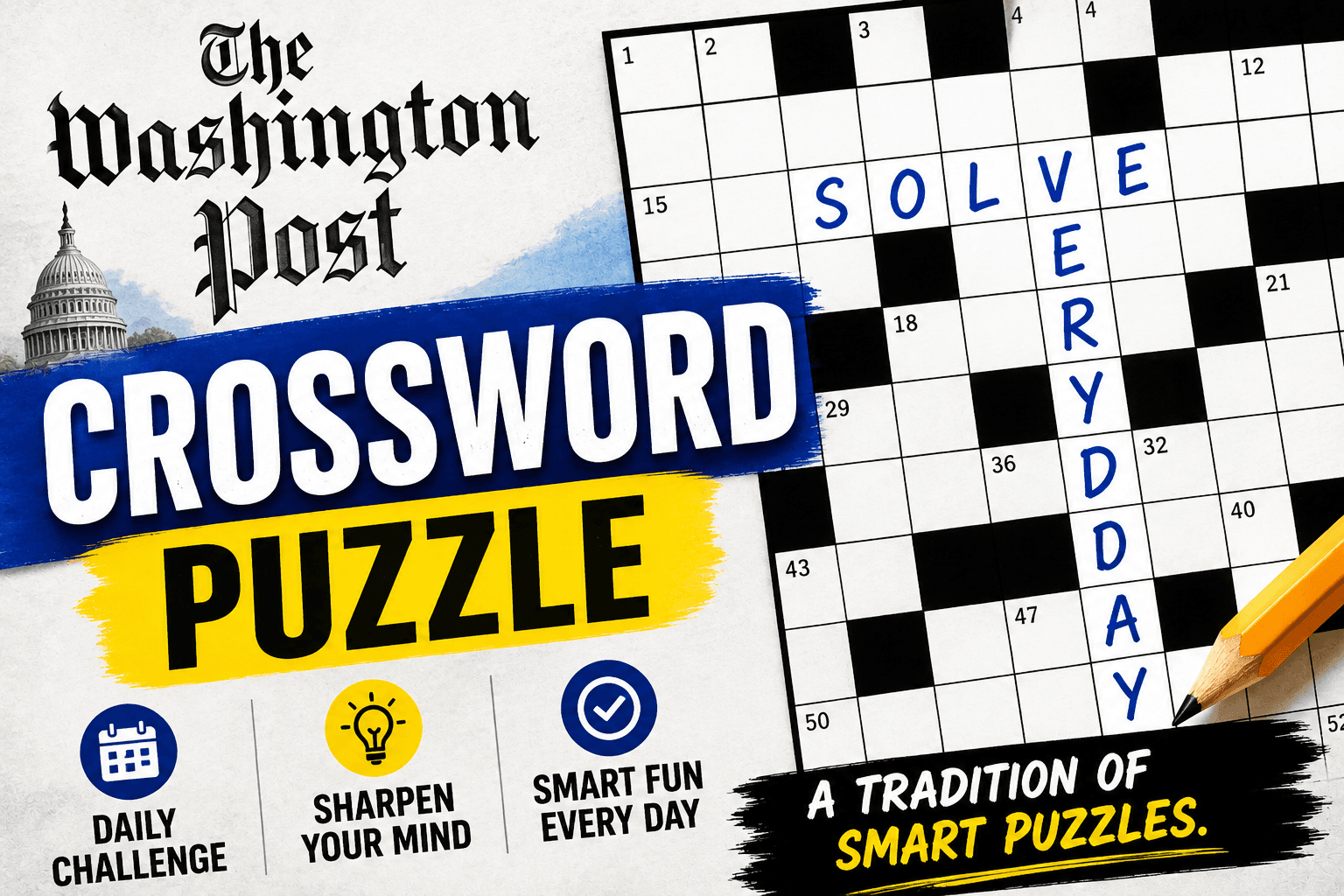
The Washington Post crossword puzzle is one of the popular online puzzle options offered through The Washington Post’s games section. Readers can play the main crossword, mini crossword, Sudoku, word games, and other puzzles from the same games hub. The Washington Post’s current games page lists Crossword, Mini Crossword, Daily Mini Meta Crossword, Sudoku, On the Record, Keyword, and Wridges among its featured games.
For many people, the Washington Post crossword is part of a daily routine. Some play it with coffee in the morning. Some use it as a short lunch break. Others save it for the evening when they want something slower than social media but more active than watching TV.
A good crossword has a simple promise: fill the grid, solve the clues, and enjoy the small satisfaction of making everything fit.
Where to Play the Washington Post Crossword Puzzle
The best place to find the Washington Post crossword puzzle is the official Washington Post Games section. The Post’s help center points readers to its enhanced puzzles and games section for both the Sunday Crossword and Daily Crossword.
The games section also includes many other casual games, including card games, word games, brain games, and daily games. On the Washington Post games site, the listed daily games include Sunday Crossword, Daily Crossword, Mini Crossword, Best Daily American Crossword, and more.
That matters because many people search for “Washington Post crossword puzzle” when they actually want one of several things:
They may want today’s crossword.
They may want the Sunday crossword.
They may want the mini crossword.
They may want crossword answers.
They may want printable crossword help.
They may want a quick puzzle to play online.
Knowing which puzzle you want saves time.
Daily Crossword vs. Sunday Crossword
The phrase Washington Post crossword puzzle can refer to more than one puzzle experience.
The daily crossword is the regular puzzle many players look for during the week. It is usually the better choice when you want a standard crossword session without committing too much time.
The Sunday crossword is larger and more of a sit-down puzzle. The Washington Post games page describes the Sunday Crossword as a large 21×21 crossword that can be played any day of the week.
That larger grid changes the feeling of the puzzle. A weekday crossword can feel like a quick challenge. A Sunday crossword feels more like a full puzzle event.
If you are new to crosswords, start with shorter puzzles first. If you already enjoy themed grids and longer solves, the Sunday crossword is probably where you will spend more time.
The Washington Post Sunday Crossword by Evan Birnholz
One of the best-known parts of the Washington Post crossword world is the Sunday puzzle by Evan Birnholz. The Washington Post identifies Birnholz as its Sunday crossword writer.
His Sunday puzzles are especially popular with solvers who like themes, wordplay, meta-style thinking, and clues that ask for more than simple dictionary knowledge.
Birnholz has also written about his long run with the Post. In a December 2025 crossword column, he noted that his first Sunday-size crossword in The Washington Post was published on December 6, 2015, and that he had been writing the Sunday crossword for the paper for 10 years.
That history gives the Sunday puzzle a recognizable voice. Regular solvers often come back not only for the grid, but for the constructor’s style.
Why People Search for Washington Post Crossword Answers
Search terms like Washington Post crossword answers, Washington Post crossword clues, and Washington Post crossword puzzle today are popular because crosswords naturally create stuck moments.
Sometimes one clue blocks a whole corner. Sometimes a name, abbreviation, or bit of wordplay refuses to click. Sometimes you know the answer is close, but the letters do not fit.
Looking up an answer is not cheating if your goal is to learn. The problem is relying on answers too early.
A better habit is this:
Try the clue first.
Use crossing letters.
Check the clue’s wording carefully.
Leave the clue and return later.
Only then look up a single answer if needed.
That way, the answer becomes a lesson instead of a shortcut.
How the Washington Post Crossword Works
A standard crossword puzzle has a grid of white and black squares. The white squares hold letters. The black squares separate words and phrases. Clues are divided into Across and Down.
Each answer crosses other answers. That is the most important part of solving.
You do not need to know every answer immediately. You use the answers you know to reveal letters in the answers you do not know.
For example, you may not know a five-letter Down answer. But if three crossing Across answers give you three letters, the answer may suddenly become obvious.
That is why good solvers move around the grid. They do not sit on one clue forever. They collect easy answers first, then use those letters to attack the harder parts.
Best Strategy for Solving the Washington Post Crossword
Crossword solving is not about being a genius. It is about habits. The more you solve, the more clue patterns you recognize.
Here are practical tips that help.
Start With the Clues You Know
Do not solve in order just because the clues are numbered.
Scan the list and fill in anything obvious first.
Good starting clues include:
Fill-in-the-blank phrases
Short common words
Plural clues
Simple definitions
Famous names you recognize
Abbreviations you already know
Every answer you place gives you letters for another answer.
One easy answer can unlock an entire corner.
Trust the Crosses
Crossing letters are the real engine of a crossword.
If you are unsure about an answer, do not force it. Check the letters that cross it. A guess may look right by itself but create nonsense in the other direction.
When several crossing answers agree with your guess, you can trust it more.
When nothing around your guess works, the guess is probably wrong.
This is one of the biggest differences between a beginner and a steady solver. Beginners often fall in love with a guess. Better solvers are willing to erase it.
Read Clues Literally, Then Read Them Again
Crossword clues often hide behind ordinary meanings.
A clue may look simple, but one word can change everything.
For example:
“Pitcher” may refer to baseball, but it can also mean a jug.
“Capital” may refer to a city, money, or an uppercase letter.
“Date” may mean a calendar day, a romantic outing, or a fruit.
“Spring” may mean a season, a coil, or a water source.
If the obvious meaning does not work, look for another meaning.
That is where crosswords become fun.
Watch for Question Marks
A clue ending with a question mark usually signals wordplay.
It is the puzzle’s way of saying, “Do not take this too directly.”
For example, a clue like “Bank job?” may not be about a robbery. It could be about a riverbank, a financial bank, or even something leaning to one side.
When you see a question mark, slow down. The answer is probably playful.
Learn Common Crossword Words
Crosswords have a shared vocabulary. Some short answers appear often because they use convenient letters.
You may see words like:
ERA
ORE
AREA
ALOE
ARIA
ERIE
ONO
ELI
EPEE
OREO
At first, these answers may feel random. After you solve enough puzzles, they become familiar.
This is not memorizing for the sake of memorizing. It is pattern recognition. The more familiar these small entries become, the easier it is to move through the grid.
Pay Attention to Clue Grammar
The clue usually matches the answer in grammar.
If the clue is plural, the answer is probably plural.
If the clue is past tense, the answer is probably past tense.
If the clue is informal, the answer may be informal.
If the clue uses an abbreviation, the answer may be abbreviated.
If the clue asks for a person, the answer is likely a name or role.
For example, a clue like “Ran quickly” probably wants a past-tense verb. A clue like “Doctors’ org.” may want an abbreviated organization.
Small grammar signals help remove bad options.
Use the Theme
Many crosswords, especially larger ones, have a theme.
The theme may involve:
A repeated phrase pattern
A hidden word
A pun
Changed letters
Added letters
Dropped letters
Common endings
A final revealer clue
Theme answers are usually longer entries. Once you understand the theme, several hard clues may become easier.
In Sunday puzzles, the theme can be the main attraction. It may not reveal itself immediately, but once it clicks, the puzzle often opens up.
Do Not Stare at One Clue Too Long
Getting stuck is normal. Staying stuck is optional.
If a clue is not working, move on. Fill another section. Come back later with more crossing letters.
This sounds simple, but it matters. A crossword is built to be solved from many directions. One clue that looks impossible with no letters may become easy with two or three letters filled in.
Leaving a clue is not giving up. It is solving efficiently.
Beginner Tips for the Washington Post Crossword Puzzle
If you are new to the Washington Post crossword puzzle, keep the first few solves relaxed. Do not worry about finishing quickly.
Your first goal is not speed. Your first goal is understanding how crossword clues behave.
A good beginner routine looks like this:
Start with the mini or an easier daily puzzle.
Fill the clues you know right away.
Use crossings before guessing.
Look up only one answer at a time.
Review the clues that fooled you.
Come back the next day and try again.
The review step is important. If a clue tricked you, ask why. Was it wordplay? A second meaning? A common abbreviation? A name you did not know?
That is how you improve.
Tips for Faster Solving
If you already solve crosswords and want better times, focus on decision-making.
Fast solvers do not know every clue. They just waste less time.
To solve faster:
Skip hard clues quickly.
Type high-confidence answers first.
Use short entries to open corners.
Watch for clue grammar.
Learn common crossword fill.
Recognize theme entries early.
Erase bad guesses quickly.
Speed comes from rhythm. You move, fill, test, and adjust.
The worst thing for speed is stubbornness. If a section is not moving, leave it and let the rest of the grid help you later.
Why the Washington Post Mini Crossword Is Useful
The Washington Post games section also lists a Mini Crossword, described as a 5×5 bite-sized crossword.
Mini crosswords are useful because they train quick recognition. You get fewer clues, fewer squares, and less room for long themes. That makes the solving experience faster and cleaner.
A mini crossword is good when you want:
A short puzzle break
A warm-up before a larger crossword
Practice with quick clue reading
A puzzle that does not take much time
The full crossword builds patience. The mini builds speed.
Both are useful.
Why the Sunday Crossword Feels Different
The Sunday crossword is larger, and that changes the way you solve.
A bigger grid gives the constructor more room for long answers, heavier themes, and more playful clueing. It also means you need more stamina.
You may not finish a Sunday puzzle in one sitting. That is fine.
A good Sunday solving approach:
Start with the easiest section.
Find the long theme answers.
Use the title if there is one.
Look for repeated tricks.
Take breaks when stuck.
Return with fresh eyes.
Sunday crosswords are often better when you slow down. Treat them less like a race and more like a weekend habit.
Common Reasons You Get Stuck
Most crossword problems fall into a few categories.
You took the clue too literally
The clue may be using a second meaning. Try another angle.
One answer is wrong
A single wrong entry can ruin a whole section. If nothing fits around it, question it.
You missed the theme
The theme may explain why the long answers feel strange.
You do not know a name
Crosswords often include authors, actors, athletes, musicians, politicians, fictional characters, and historical figures.
You ignored the clue’s grammar
Plural clues, abbreviations, and verb tenses matter.
You are tired
Sometimes the puzzle is not the problem. Your focus is.
Take a break. Many crossword answers appear after you stop forcing them.
Should You Print the Washington Post Crossword?
Some solvers prefer paper. It lets them write notes, circle clues, and work without screen distractions.
The Washington Post help center has a support article specifically about printing crosswords, which shows that print solving is still part of the experience for many readers.
Online solving is convenient, especially on a phone or laptop. Paper solving feels slower and more deliberate.
Neither is better. Use the format that keeps you solving.
Washington Post Crossword Answers: Best Way to Use Them
There are two bad ways to use crossword answers.
The first is looking up the whole grid before trying.
The second is refusing to look up anything and quitting completely.
The better middle ground is to use answers as help, not as replacement solving.
Look up one clue when you are truly blocked. Then study why the answer works.
Was it a pun?
Was it an abbreviation?
Was it a name?
Was the clue using a second meaning?
Was there a theme trick?
That small review helps you solve better next time.
Why People Keep Playing the Washington Post Crossword
Crosswords last because they create a rare kind of quiet focus.
A crossword gives you a problem with edges. The grid is fixed. The clues are fixed. Every answer must connect. When the puzzle is finished, it is finished.
That is satisfying.
The Washington Post crossword puzzle also has variety. One day may be light and quick. Another may be tricky. A Sunday puzzle may ask for more time and patience. The mini may give you a fast break.
That range keeps the habit fresh.
Washington Post Crossword Puzzle FAQ
Is the Washington Post crossword puzzle online?
Yes. The Washington Post directs readers to its enhanced puzzles and games section for the Sunday Crossword and Daily Crossword.
Does The Washington Post have a mini crossword?
Yes. The Washington Post games page lists a Mini Crossword and describes it as a 5×5 bite-sized crossword.
Who writes the Washington Post Sunday crossword?
Evan Birnholz is listed by The Washington Post as the Sunday crossword writer.
Is the Washington Post Sunday crossword larger than a regular crossword?
The Washington Post games page describes the Sunday Crossword as a large 21×21 crossword.
Why do people search for Washington Post crossword answers?
Usually because they are stuck on a clue, checking a finished puzzle, or trying to understand a tricky answer.
What is the best way to get better at crosswords?
Solve regularly, start with easier clues, trust crossing letters, learn common crossword words, and review clues that fooled you.
The Washington Post crossword puzzle is popular because it gives solvers a steady mix of routine and challenge. You can play a quick mini, work through a daily crossword, or sit down with a larger Sunday puzzle when you have more time.
For beginners, the best advice is simple: do not rush, do not panic, and do not solve in order just because the clues are numbered. Fill what you know, use the crosses, and let the grid open up piece by piece.
For regular solvers, the appeal is deeper. You start to notice clue habits, theme styles, repeated words, and small editorial choices. The puzzle becomes less of a random challenge and more of a language game you slowly learn to read.
That is the real reason people keep coming back. A crossword is not just a test of what you know. It is a test of how flexibly you can think.
🔥 Related Posts

Advanced 24 Game 2026: Free Online Math Puzzle

NYT Wordle Hint Today: Game #1351, Saturday, March 1

NYT Wordle Answers Today: Tuesday, June 6—Ultimate Guide for U.S. Players
Word Search Puzzles 2026: Free Online Daily Play

NYT Wordle Hint Today: Monday, May 12, Game #1423 – Daily Clue & Tips for Wordle Fans