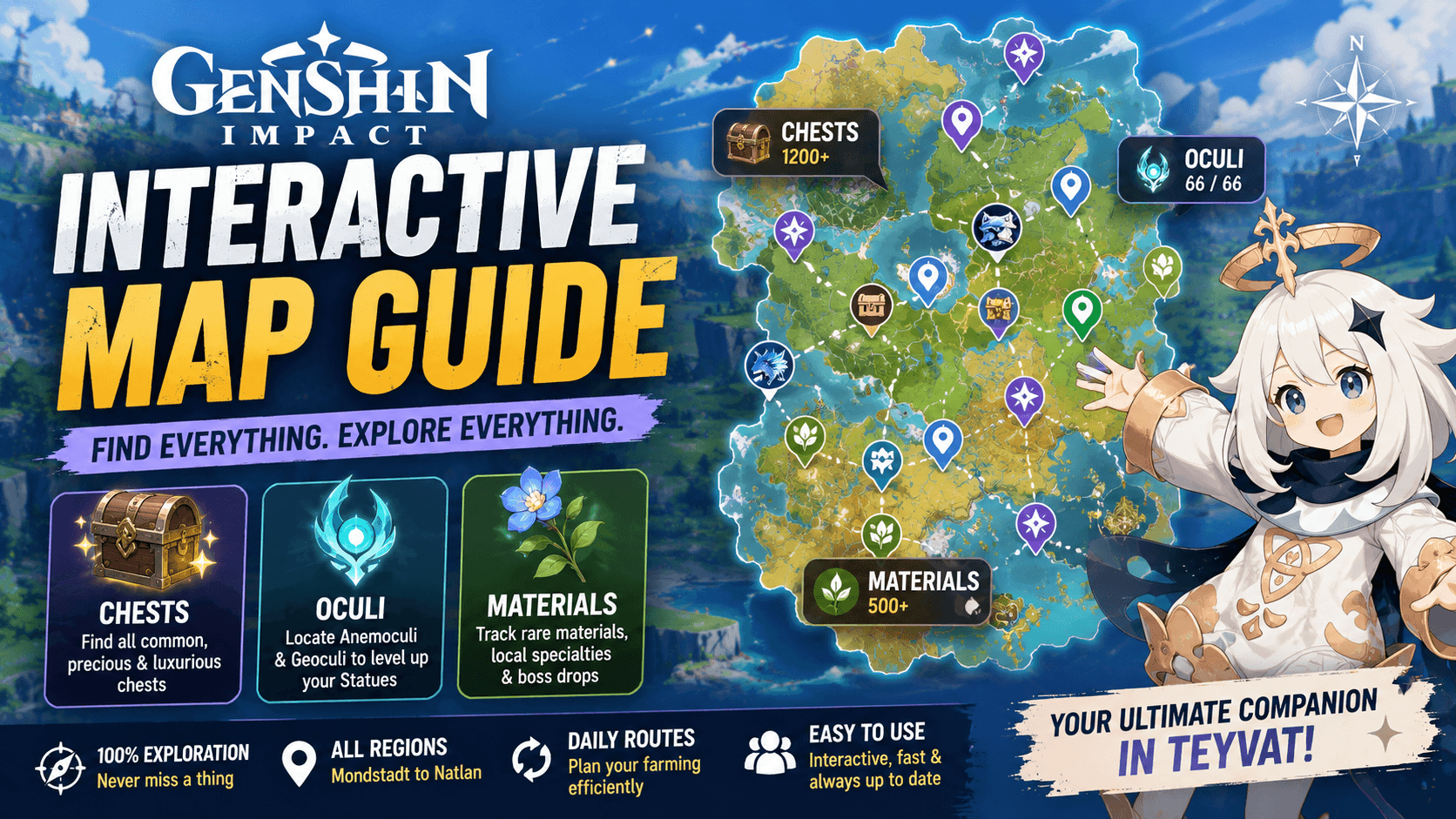
A Genshin interactive map is one of the most useful tools a player can use while exploring Teyvat. Genshin Impact is a huge open-world game, and even careful players can miss chests, oculi, local specialties, puzzles, bosses, time trials, and hidden collectibles. The interactive map solves that problem by showing important locations on a searchable digital map.
Instead of running around blindly and hoping you find the last missing chest in Mondstadt, Liyue, Inazuma, Sumeru, Fontaine, Natlan, or another region, you can open the map, filter what you need, and follow the markers. It saves time, reduces frustration, and makes exploration feel more organized.
For new players, the map is helpful because Genshin can feel overwhelming at first. There are materials for characters, materials for weapons, regional specialties, enemy drops, artifacts, domains, bosses, quests, puzzles, and collectible systems. For long-time players, the map is useful for completion. If you are stuck at 98% exploration in a region, a good interactive map can help you find what you missed.
The best part is that a Genshin interactive map is not only for hardcore players. Casual players can use it too. You do not have to mark every single chest or follow every farming route. You can simply use it when you need help finding something specific.
Quick Overview of the Genshin Interactive Map
| Feature | Why It Helps |
|---|---|
| Searchable map | Quickly find chests, oculi, bosses, domains, materials, and puzzles |
| Filters | Show only the items you need instead of cluttering the map |
| Material tracking | Helps you farm character and weapon upgrade materials |
| Exploration support | Useful for reaching 100% exploration in each region |
| Pin marking | Lets you mark what you already collected |
| Farming routes | Helps save time when collecting repeatable materials |
| Region navigation | Makes it easier to explore large areas of Teyvat |
| Beginner support | Reduces confusion for new players |
Why Players Search for “Genshin Interactive Map”
Most players search for “Genshin interactive map” when they are stuck. Maybe they need one more Anemoculus. Maybe they are farming local specialties for a new character. Maybe they are trying to collect every chest in a region before moving on. Or maybe they watched a guide that mentioned a hidden puzzle and now they want the exact location.
That is why the search intent behind this keyword is very practical. People are not looking for a long theory article. They want a clear answer, a useful guide, and a reason to choose one map over another. They want to know what the map does, how to use it, which filters matter, and whether it can help them save time.
A strong Genshin interactive map guide should answer those needs directly. It should explain the tool in plain language, show how players can use it, and help beginners avoid common mistakes.
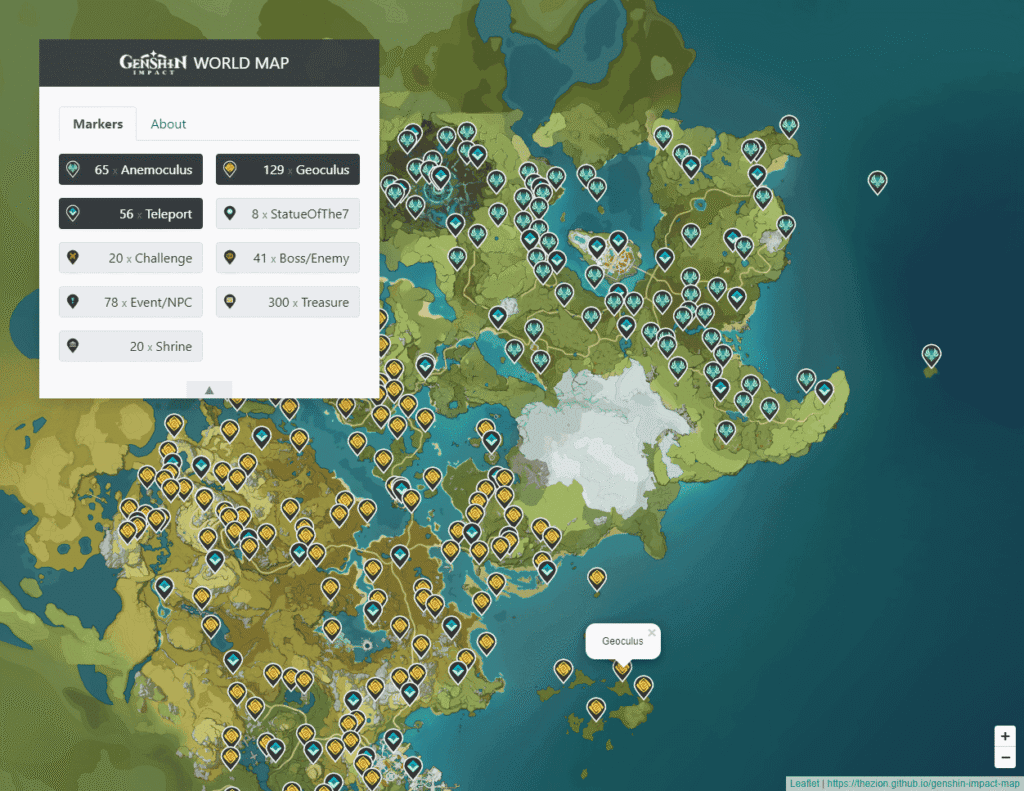
Best Genshin Interactive Map Options
There are two main types of Genshin interactive maps: the official HoYoLAB Teyvat Interactive Map and third-party maps made by community tools or fan sites. Both can be useful, but they are not always the same.
The official map is the safest option for most players because it comes from HoYoLAB and is connected to the Genshin ecosystem. It is designed for players who want a reliable tool for exploration, materials, monsters, and pin tracking. Third-party maps can also be helpful, especially when they offer extra notes, comments, community tips, or a layout some players prefer.
The best choice depends on how you play. If you want the official experience, start with HoYoLAB. If you want extra community-style details or a different interface, try a trusted third-party map.
| Map Type | Best For | Main Benefit |
| Official HoYoLAB Teyvat Interactive Map | Most players | Official tool with map filters and exploration markers |
| AppSample Genshin Impact Map | Players who like community-style tools | Searchable layout with many collectible and puzzle markers |
| Wiki-supported maps and guides | Players checking exact item details | Useful for item names, quest context, and extra explanation |
| YouTube route guides | Players who prefer video help | Good for hard-to-reach chests and puzzle walkthroughs |
Official Teyvat Interactive Map vs Third-Party Maps
The official Teyvat Interactive Map is usually the best starting point. It gives you a clean way to look up resources, oculi, enemies, domains, materials, and other map items. It also fits naturally with the HoYoLAB ecosystem, which many Genshin players already use for daily check-ins, account tools, events, and community posts.
Third-party maps can be better for certain players because they sometimes feel faster, simpler, or more detailed in specific areas. Some players like community notes and comments because they explain how to reach a hidden cave, unlock a puzzle, or find an underground entrance. That kind of practical detail can be useful when a marker alone is not enough.
For most players, the best approach is to use the official map first and keep a third-party map as a backup when you cannot find something.
| Feature | Official HoYoLAB Map | Third-Party Maps |
| Official source | Yes | No |
| Good for beginners | Yes | Yes, depending on layout |
| Material locations | Yes | Usually yes |
| Chest and puzzle markers | Yes | Usually yes |
| Community comments | Limited or varies | Often stronger |
| Account ecosystem | Better | Depends on the site |
| Best use | Main exploration tool | Backup tool for extra detail |
How to Use a Genshin Interactive Map
Using a Genshin interactive map is simple once you understand filters. The biggest mistake new players make is turning on every marker at once. When you do that, the map becomes crowded and hard to read. A better way is to search for one goal at a time.
If you are farming materials for a character, select only that material. If you are hunting oculi, select only the oculus type for that region. If you are looking for chests, start with one chest category or one area instead of the whole map. This makes the map easier to follow and keeps the process from feeling like work.
The map works best when you use it with a clear plan. Do not open it and try to clear all of Teyvat in one day. Pick one region, one route, or one material. That is how you get value without burning out.
Step-by-Step Beginner Method
| Step | What to Do | Why It Matters |
| 1 | Choose the region you are exploring | Keeps the map focused |
| 2 | Turn on only one or two filters | Prevents marker overload |
| 3 | Start from a teleport waypoint | Makes the route easier |
| 4 | Collect items in a small area | Helps you stay organized |
| 5 | Mark completed locations | Prevents repeating the same spot |
| 6 | Check difficult markers with a guide if needed | Helps with caves, puzzles, and underground areas |
| 7 | Stop after one route | Avoids exploration fatigue |
Best Things to Track With a Genshin Interactive Map
The most common reason to use a Genshin interactive map is to find collectibles. Genshin has many items hidden behind cliffs, trees, caves, buildings, water areas, puzzles, and underground paths. Some are easy to see. Others are easy to miss even after you walk past them several times.
Oculi are one of the biggest reasons players use maps. Every major region has its own collectible tied to Statues of The Seven. Missing one or two can be annoying, especially when you have already explored the area. A map makes the search much easier.
Character materials are another major use. If you are building a character, you often need regional specialties. These materials can be scattered across the map and may respawn after a period of time. A map helps you plan farming routes instead of wandering around randomly.
| Item Type | Why Players Track It |
| Oculi | Needed for Statue of The Seven upgrades |
| Chests | Help with exploration progress, Primogems, Mora, and materials |
| Local specialties | Needed for character ascension |
| Bosses | Needed for character upgrade materials |
| Domains | Needed for artifacts, talents, and weapons |
| Enemy locations | Useful for farming drops |
| Puzzles | Needed for hidden rewards and exploration progress |
| Time trials | Useful for chests and completion |
| Fishing spots | Helpful for fish collection and weapon rewards |
| Viewpoints | Useful for archive completion |
Using the Map for Character Materials
Character building is one of the best reasons to use a Genshin interactive map. Every character needs different ascension materials, and many of those materials come from specific regions. If you pull a new character and want to level them quickly, the map can save hours.
For example, if a character needs a local specialty from one region, you can filter that material and create a farming route. Instead of checking random areas, you can move from marker to marker. This is especially helpful when the material is hidden near cliffs, inside caves, or spread across a wide area.
A good habit is to farm materials before you need them. If you know you want to build a character later, start collecting their regional specialty early. That way you are not stuck waiting for materials when you finally get the character.
Using the Map for Chests and 100% Exploration
Many players use a Genshin interactive map because they want 100% exploration. This sounds simple, but Genshin exploration can be tricky. Some chests are locked behind puzzles. Some are hidden underground. Some appear only after defeating enemies or completing a challenge. Some are tied to quests that change the environment.
The map helps by showing possible chest locations, but it does not always mean the chest is sitting in plain sight. Sometimes the marker shows the general area, and you still need to solve a puzzle, enter a cave, follow a Seelie, light torches, break rocks, or finish a nearby challenge.
This is why players should not treat the map like a magic button. It is a guide. You still have to explore carefully. If a marker seems wrong, look above, below, behind walls, or underground. Genshin loves vertical exploration, and many missed rewards are not on the same level as your character.
Common Exploration Problems and Fixes
| Problem | Possible Reason | What to Try |
| Marker says chest is there, but you cannot see it | Chest may be underground or locked behind a puzzle | Check nearby caves, cliffs, and puzzle objects |
| You are stuck at 98% exploration | Missing small chests, puzzles, time trials, or hidden areas | Filter by chest, puzzle, and challenge markers |
| Material is not there | It may have been collected already or not respawned yet | Return later and mark collected spots |
| Oculus is hard to reach | It may be above or below you | Use elevation, gliding points, and nearby structures |
| Too many markers appear | Too many filters are turned on | Use only one category at a time |
| Route feels slow | You are moving without a plan | Start from waypoints and clear small sections |
Why the Genshin Interactive Map Is Important for New Players
New players often underestimate how large Genshin Impact becomes after the first few hours. At the beginning, Mondstadt feels manageable. Then Liyue opens up. Then more regions, underground areas, islands, deserts, forests, cities, mountains, and quest-locked zones appear. The world becomes much bigger than expected.
The interactive map helps new players build better habits early. Instead of ignoring collectibles and regretting it later, you can mark what you find. Instead of waiting until you are desperate for materials, you can learn where they grow. Instead of wasting time searching for one missing oculus, you can check possible locations in a few minutes.
This does not mean new players should use the map for everything. In fact, it is better to explore naturally at first. Genshin is more enjoyable when you discover things on your own. But when you get stuck, the map is there to help.
The best balance is simple: explore freely first, use the map when you need direction.
Best Filters to Use First
A good Genshin interactive map has many filters, but beginners do not need all of them right away. Start with the filters that solve immediate problems.
If you are leveling a character, use local specialties and boss materials. If you are trying to increase exploration, use oculi, chests, Seelies, and time trials. If you are building weapons or talents, use enemy materials and domains.
| Player Goal | Best Map Filters |
| Level up a character | Local specialties, bosses, enemy drops |
| Upgrade talents | Talent domains, weekly bosses, enemy drops |
| Find Primogems | Chests, quests, puzzles, time trials |
| Increase exploration percentage | Chests, oculi, viewpoints, Seelies, challenges |
| Build weapons | Weapon domains, ore locations, enemy drops |
| Complete regional collectibles | Oculi, sigils, region-specific items |
| Farm daily routes | Local specialties, ore, enemies |
Genshin Interactive Map for Farming Routes
Farming routes are where the interactive map becomes really powerful. A farming route is simply a planned path that takes you from one useful location to another. Instead of teleporting randomly, you follow a path that collects many items in less time.
This is especially helpful for local specialties, ore, enemy drops, and plants. Some materials are spread far apart, and it can be annoying to remember every location. The map lets you turn on a material filter, start near a waypoint, and collect everything in a planned order.
For serious players, farming routes make character building much easier. For casual players, they reduce frustration. You do not need to memorize the entire world. You only need to follow a simple route.
Sample Farming Route Planning Table
| Farming Goal | Route Style | Best Practice |
| Local specialties | Region-based route | Start near waypoints and mark collected spots |
| Ore farming | Cluster route | Focus on high-density mining areas |
| Enemy drops | Enemy path route | Use filters for specific enemy types |
| Artifact fodder | Daily collection route | Follow repeatable investigation spots |
| Fishing | Spot-to-spot route | Mark fishing pools and return later |
| Weekly boss prep | Domain and boss checklist | Track resin and material needs |
Does the Genshin Interactive Map Sync With the Game?
This is one of the most common questions players ask. The map can support useful pin-related features, but players should not assume every collected chest, puzzle, oculus, and material will automatically appear as completed on the interactive map. In many cases, you still need to manually mark what you have collected.
That is important because some players open the map after months of playing and expect it to know everything they already found. If you did not mark items earlier, you may need to compare the map with your in-game progress. This can take time, especially if you are trying to clean up older regions.
The best habit is to mark things as you collect them. If you are starting fresh in a new region, use the map from the beginning. That makes tracking much easier later.
Best Way to Use the Map Without Spoiling Exploration
Some players avoid interactive maps because they feel maps ruin the fun. That is fair. Genshin is built around discovery, and checking every marker can make exploration feel like homework.
The better approach is to use the map lightly. First, explore the area naturally. Open chests, solve puzzles, follow Seelies, and enjoy the region. After that, use the interactive map for cleanup. This way, you get both experiences: natural discovery first and completion help later.
This method works especially well for new regions. Do not turn the game into a checklist on day one. Let yourself enjoy the world. Then, when you are ready to farm materials or finish exploration, use the map as a helper.
Best Use Cases for Casual and Serious Players
| Player Type | Best Way to Use the Map |
| Casual player | Use it only when stuck or farming materials |
| New player | Use it for oculi, bosses, and character materials |
| Completionist | Mark every chest, puzzle, and collectible |
| Spiral Abyss-focused player | Farm materials quickly for character builds |
| Lore/exploration player | Use it after exploring naturally |
| Returning player | Use it to catch up on missed regions and resources |
Genshin Interactive Map on Mobile vs Desktop
Both mobile and desktop can work, but desktop is usually better for long exploration sessions. A larger screen makes it easier to view markers, zoom in, compare areas, and plan routes. Mobile is better when you are playing on console or away from your computer.
If you play Genshin on PC, opening the map in a browser on a second monitor is ideal. If you play on PlayStation, Xbox, or mobile, you can use your phone or tablet beside you. The best setup is the one that lets you check locations quickly without interrupting your gameplay too much.
| Device | Best For | Main Weakness |
| Desktop browser | Long farming routes and detailed exploration | Not convenient if you play away from your desk |
| Mobile browser/app | Quick checks while playing console or mobile | Smaller screen can feel crowded |
| Tablet | Best balance for map viewing | Depends on layout and browser support |
| Second monitor | Serious farming and completion tracking | Requires a PC setup |
Tips to Use the Genshin Interactive Map Better
The first tip is to avoid marker overload. Turning on every filter makes the map almost useless. Use one goal at a time.
The second tip is to mark completed items immediately. If you say, “I’ll mark it later,” you will probably forget. That is how players end up confused about which chests they already collected.
The third tip is to check vertical space. Genshin’s world is full of cliffs, caves, rooftops, underground paths, and hidden entrances. A marker may be correct, but the item may not be on your current level.
The fourth tip is to combine the map with short guides when needed. Some puzzles are not obvious from a marker alone. If you cannot solve something after a few minutes, search for a quick video or written walkthrough.
The fifth tip is to use the map for planning, not just searching. Before you start farming, decide what you need. That turns a messy exploration session into a clean route.
Common Mistakes Players Make
| Mistake | Why It Hurts | Better Habit |
| Turning on every filter | Makes the map too crowded | Use one or two filters at a time |
| Not marking collected items | Creates confusion later | Mark items immediately |
| Using the map too early | Can spoil natural exploration | Explore first, clean up later |
| Ignoring underground areas | Leads to missed chests and oculi | Check caves, tunnels, and lower levels |
| Farming without a route | Wastes time | Start from waypoints and move in order |
| Trusting only one marker view | Some items need extra context | Use notes, guides, or videos when stuck |
Is a Genshin Interactive Map Worth Using?
Yes, a Genshin interactive map is worth using, especially if you care about character building, exploration progress, Primogems, materials, or completion. It is one of those tools that becomes more valuable the longer you play.
New players can use it to reduce confusion. Returning players can use it to catch up. Completionists can use it to clear regions. Character builders can use it to farm faster. Even casual players can use it when they are stuck and do not want to waste half an hour looking for one item.
The only time you may not want to use it is during your first natural exploration of a new region. If you love discovering things on your own, wait before opening the map. But after that, it becomes one of the most practical tools in the game.
Final Verdict: The Best Way to Use the Genshin Interactive Map
The best way to use a Genshin interactive map is to treat it as a smart assistant, not a replacement for exploration. Let the game surprise you first. Then use the map to clean up missing chests, find oculi, farm materials, and plan efficient routes.
For most players, the official HoYoLAB Teyvat Interactive Map is the best place to start. It is reliable, built for Genshin players, and useful for tracking resources and exploration. Third-party maps can also help when you need extra comments, alternate layouts, or more community-style guidance.
If you are new to Genshin Impact, do not try to clear everything at once. Pick one goal. Find one material. Finish one route. Mark what you collect. That simple habit will save you a lot of time later.
A Genshin interactive map will not make the game easier in a bad way. It simply removes unnecessary frustration. You still explore, fight, solve puzzles, climb mountains, glide across regions, and build your characters. The map just helps you stop missing the things you actually came to find.
FAQ About Genshin Interactive Map
What is the best Genshin interactive map?
The official HoYoLAB Teyvat Interactive Map is the best starting point for most players. It is official, easy to use, and covers important resources, monsters, collectibles, and exploration markers. Third-party maps can also be useful for extra notes and community-style help.
Is the Genshin interactive map official?
HoYoLAB has an official Teyvat Interactive Map for Genshin Impact. There are also third-party interactive maps made by community tools and fan sites.
Can I use the Genshin interactive map to find chests?
Yes, interactive maps can help you find chest locations. Some chests may still require puzzles, enemies, quests, or hidden entrances before they appear.
Can the interactive map show oculi locations?
Yes, a Genshin interactive map is very useful for finding oculi in different regions. This is one of the main reasons players use it.
Does the Genshin interactive map track everything automatically?
Not everything should be expected to track automatically. Players often need to mark collected items manually, especially chests, puzzles, and exploration progress.
Is the Genshin interactive map good for farming materials?
Yes, it is excellent for farming character materials, local specialties, ore, enemies, bosses, and other upgrade resources.
Should beginners use the interactive map?
Beginners should use it when they need help, but they do not need to follow it constantly. It is better to explore naturally first and use the map for farming or cleanup.
Can I use the map for 100% exploration?
Yes, the map can help with 100% exploration by showing chests, puzzles, oculi, time trials, Seelies, and other hidden objectives. However, some locations may still require careful searching in-game.
🔥 Related Posts

Jewel Quest iWin – Full Gameplay Guide, Levels, Storyline, Tips & Player Experience Review

The Ultimate Chrome Dino Guide: History, Tips, Secrets, and How to Master the Endless Runner

Valorant Crosshair — The Complete, Practical Guide to Finding Your Perfect Aim

Minecraft Shaders — The Complete Guide (Install, Best Packs, Performance & FAQ)
GTA 6 map locations explained: Vice City, Leonida, and hidden areas