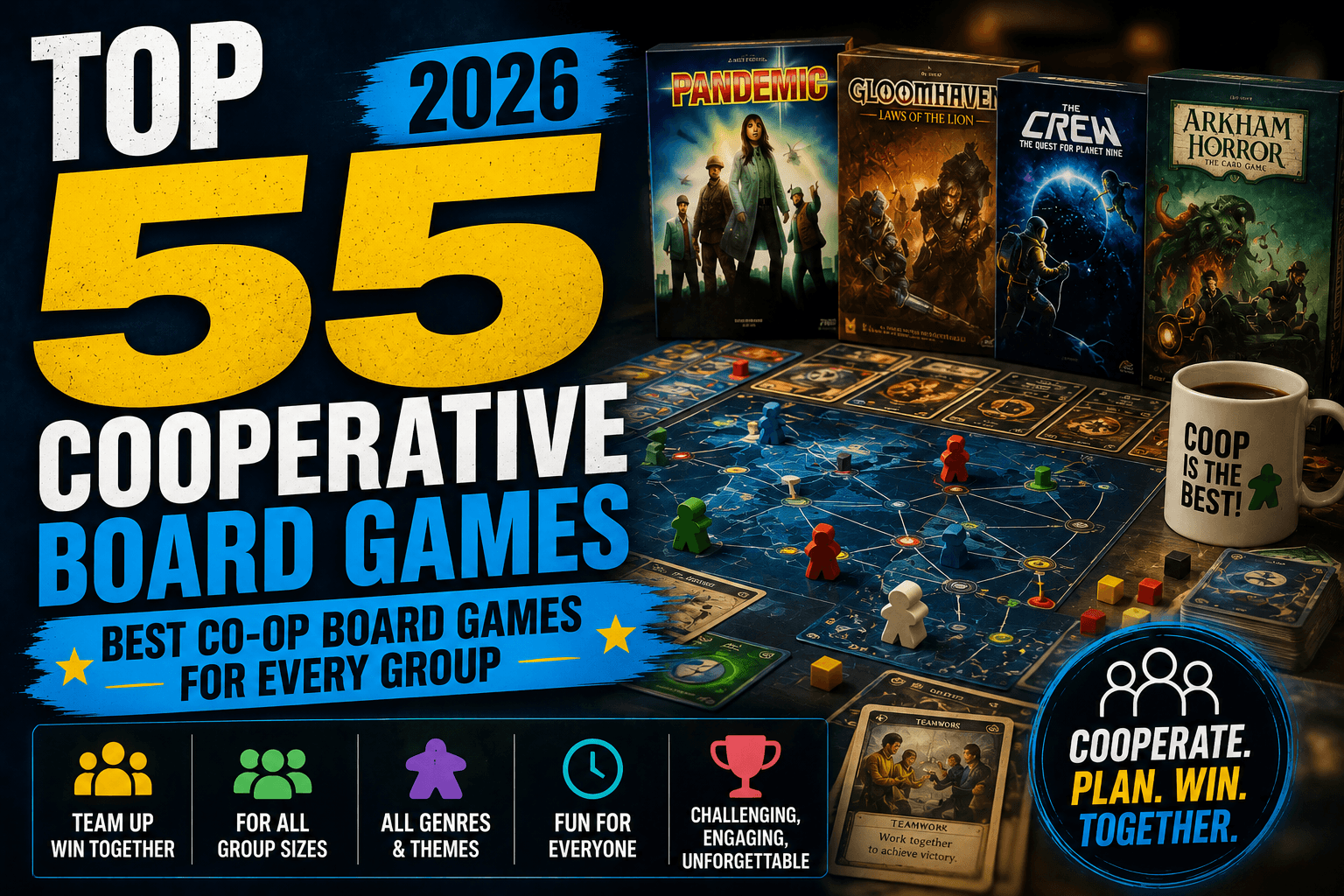
Cooperative board games have become one of the strongest categories in modern tabletop gaming. Instead of competing against each other, players work together against the game itself. Everyone wins together or loses together.
That one change makes a huge difference.
A good cooperative board game creates shared tension, table talk, teamwork, problem-solving, and memorable stories. You are not trying to crush your friends. You are trying to survive a haunted house, cure global diseases, defuse bombs, protect an island, escape a dungeon, save a kingdom, or land an airplane before everything goes wrong.
That is why co-op board games work so well for families, couples, casual game nights, experienced gamers, and groups that do not enjoy direct conflict.
In 2026, the cooperative board game world is bigger than ever. There are quick card games, heavy strategy games, legacy campaigns, escape-room games, mystery games, dungeon crawlers, horror adventures, family games, and smart two-player designs.
This guide ranks 55 of the best cooperative board games to play in 2026, with a mix of modern classics, beginner-friendly games, deep strategy titles, family favorites, and newer standout releases.
Quick Comparison: Best Cooperative Board Games by Category
| Category | Best Picks |
|---|---|
| Best Overall Co-Op Game | Spirit Island |
| Best Family Co-Op Game | Forbidden Island |
| Best Beginner Co-Op Game | Pandemic |
| Best Two-Player Co-Op Game | Sky Team |
| Best Party Co-Op Game | Just One |
| Best Campaign Co-Op Game | Gloomhaven: Jaws of the Lion |
| Best Heavy Strategy Co-Op Game | Mage Knight |
| Best Horror Co-Op Game | Arkham Horror: The Card Game |
| Best Puzzle Co-Op Game | Bomb Busters |
| Best Real-Time Co-Op Game | Magic Maze |
| Best Word-Based Co-Op Game | Codenames: Duet |
| Best Family Mystery Co-Op Game | Mysterium |
| Best App-Assisted Co-Op Game | Mansions of Madness: Second Edition |
| Best Adventure Co-Op Game | Sleeping Gods |
| Best Lord of the Rings Co-Op Game | Fate of the Fellowship |
What Makes a Great Cooperative Board Game?
A great co-op board game should make players feel like their choices matter. It should create tension without feeling unfair. It should encourage discussion without letting one loud player control the whole table.
The best cooperative games usually have these features:
- Clear shared goal
- Meaningful player roles
- Real teamwork
- Tension that grows over time
- Replay value
- Good pacing
- Balanced difficulty
- Strong theme
- Smart challenge from the game system
- Room for different strategies
The biggest weakness in some co-op games is called the “alpha player problem.” This happens when one experienced player tells everyone else what to do. The best modern cooperative games reduce this problem by using hidden information, simultaneous choices, personal hands of cards, real-time pressure, or unique player abilities.
Top 55 Cooperative Board Games 2026
1. Spirit Island

Best for: Strategy gamers who want deep cooperative gameplay
Players: 1–4
Game Type: Heavy strategy, area control, anti-colonial fantasy
Difficulty: Advanced
Spirit Island is one of the best cooperative board games ever made because it gives players real strategic depth without turning the game into a simple puzzle. Each player controls a powerful spirit defending an island from invading colonizers. The invaders explore, build, and ravage the land while the spirits use unique powers to push them back.
What makes Spirit Island special is the way every spirit feels different. Some spirits spread fear. Some control the board. Some destroy invaders directly. Some grow slowly and become terrifying later. The game rewards teamwork, planning, and creative problem-solving.
It is not the easiest game to teach, but for players who enjoy serious strategy, Spirit Island is a must-play co-op board game in 2026.
Why it stands out: Deep strategy, strong theme, high replayability, and very little quarterbacking.
2. Pandemic
Best for: Beginners and classic co-op game nights
Players: 2–4
Game Type: Global crisis management
Difficulty: Easy to medium
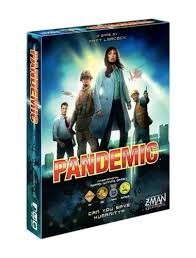
Pandemic remains one of the most important cooperative board games because it explains the genre so clearly. Players work together as specialists trying to stop diseases from spreading around the world. Every turn brings new infections, outbreaks, and pressure.
The rules are simple enough for new players, but the decisions are still meaningful. Should you treat disease cubes, travel to another city, trade a card, build a research station, or push toward a cure?
Pandemic is the game many people use to introduce friends and family to cooperative board gaming.
Why it stands out: Easy to learn, tense, replayable, and still one of the best gateways into co-op games.
3. Gloomhaven: Jaws of the Lion
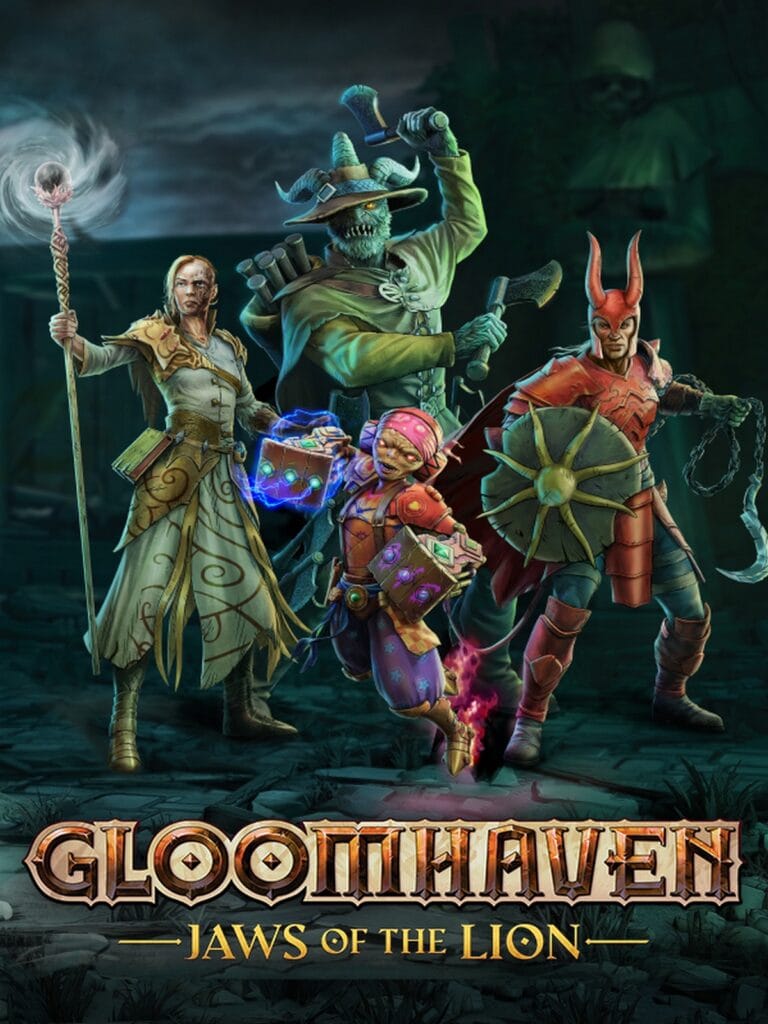
Best for: Players who want a campaign without starting too heavy
Players: 1–4
Game Type: Tactical dungeon campaign
Difficulty: Medium to advanced
Gloomhaven: Jaws of the Lion is one of the best ways to enter the Gloomhaven universe. It keeps the tactical combat, character progression, card management, and campaign feeling of Gloomhaven, but makes the experience easier to set up and learn.
Players control mercenaries fighting through linked scenarios. The combat is card-driven, smart, and punishing in a good way. You cannot simply attack every turn. You must manage your hand, position carefully, and coordinate with teammates.
This is an excellent pick for a group that wants a regular campaign game but does not want to commit immediately to the massive original Gloomhaven box.
Why it stands out: Great tutorial system, strong tactical combat, and a more approachable campaign structure.
4. Pandemic Legacy: Season 1

Best for: Groups that want an unforgettable campaign
Players: 2–4
Game Type: Legacy campaign
Difficulty: Medium
Pandemic Legacy: Season 1 takes the familiar Pandemic system and turns it into a story-driven campaign where the board, rules, characters, and world change over time.
Every session matters. Characters can gain scars. Cities can become unstable. New rules appear. New threats change the way you think. The campaign creates emotional stakes that normal one-off games rarely reach.
This is not the game to buy if you want endless replay from the same box, because legacy games are designed around permanent changes. But if you want a memorable shared experience, it is still one of the strongest cooperative campaigns ever made.
Why it stands out: One of the most influential and emotional legacy board games.
5. The Crew: Mission Deep Sea
Best for: Card players who enjoy quiet teamwork
Players: 2–5
Game Type: Cooperative trick-taking
Difficulty: Medium
The Crew: Mission Deep Sea is a brilliant cooperative card game where players must complete missions by winning certain cards in specific ways. The twist is that communication is limited. You cannot simply tell everyone what you have.
This creates smart tension. Every card played matters. Every clue matters. Every mistake can sink the mission.
Mission Deep Sea improves flexibility compared with the original The Crew by offering varied mission goals, making it feel fresh across many plays.
Why it stands out: Small box, clever teamwork, huge replay value.
6. Sky Team
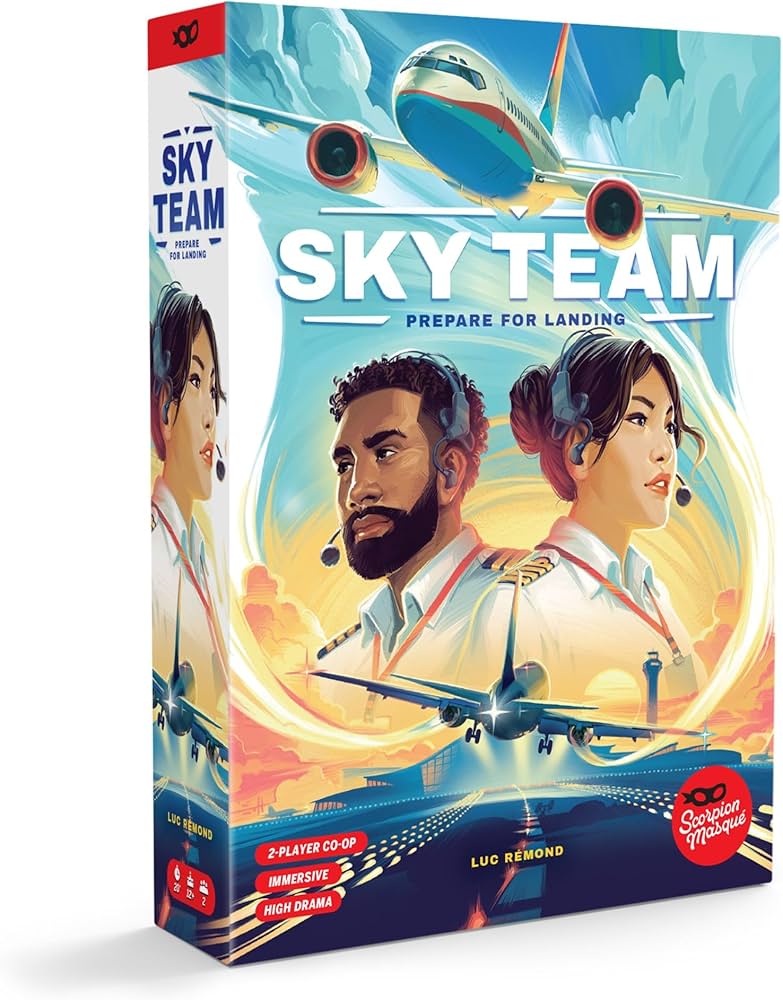
Best for: Two-player couples, friends, and strategy partners
Players: 2
Game Type: Dice placement, airplane landing
Difficulty: Medium
Sky Team is one of the best two-player cooperative board games because the theme is instantly understandable. Two players act as pilot and co-pilot trying to land an airplane safely.
Each round, players roll dice secretly and place them into cockpit controls. You must manage speed, altitude, flaps, landing gear, communication, and approach path. The tension feels real without becoming overwhelming.
Sky Team works especially well because both players feel important. It is not one player solving everything while the other watches.
Why it stands out: Excellent two-player design, strong theme, quick sessions, and satisfying teamwork.
7. Bomb Busters
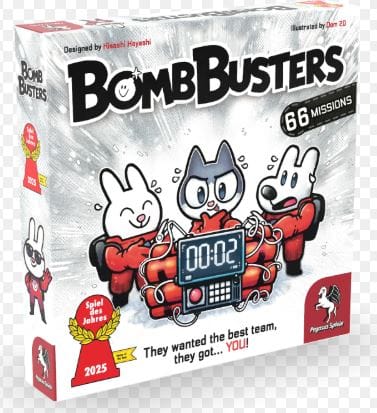
Best for: Puzzle lovers and family strategy groups
Players: 2–5
Game Type: Cooperative deduction
Difficulty: Easy to medium
Bomb Busters is a clever cooperative deduction game about defusing bombs by cutting the correct wires. Players have hidden information, limited clues, and a shared goal. The tension builds because one wrong move can cause disaster.
It is easy to teach but surprisingly tense. The game also includes many scenarios, giving groups a reason to come back again and again.
For 2026, Bomb Busters is one of the strongest modern co-op games for families and mixed-experience groups.
Why it stands out: Fresh deduction gameplay, great table tension, and accessible rules.
8. Fate of the Fellowship
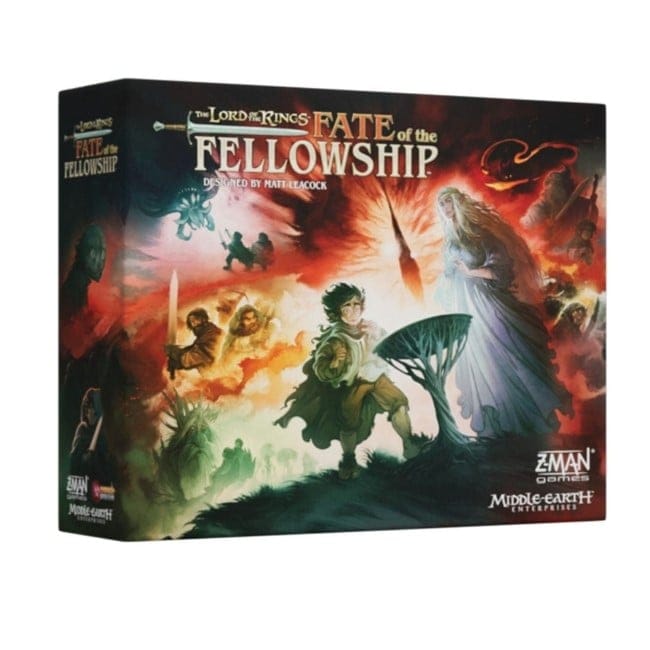
Best for: Lord of the Rings fans and Pandemic-style co-op players
Players: 1–5
Game Type: Adventure strategy
Difficulty: Medium
Fate of the Fellowship brings cooperative adventure into Middle-earth. Players work together to protect regions, complete objectives, manage danger, and guide the story toward the destruction of the One Ring.
The game appeals to players who enjoy the structure of Pandemic-style cooperative systems but want a richer fantasy theme and more narrative flavor.
It is a strong pick for groups that want a Lord of the Rings experience without jumping into a huge campaign game.
Why it stands out: Big theme, cooperative tension, and strong appeal for Tolkien fans.
9. Forbidden Island
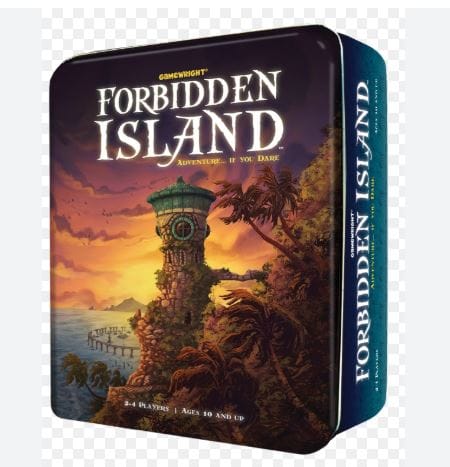
Best for: Families and new gamers
Players: 2–4
Game Type: Adventure, tile survival
Difficulty: Easy
Forbidden Island is one of the best beginner cooperative board games. Players explore a sinking island, collect treasures, and try to escape before the island disappears under the water.
The rules are simple, the tension is easy to understand, and the game is affordable compared with many larger co-op titles.
It is a perfect first cooperative game for families, kids, and casual players.
Why it stands out: Simple rules, fast setup, great entry point.
10. Forbidden Desert
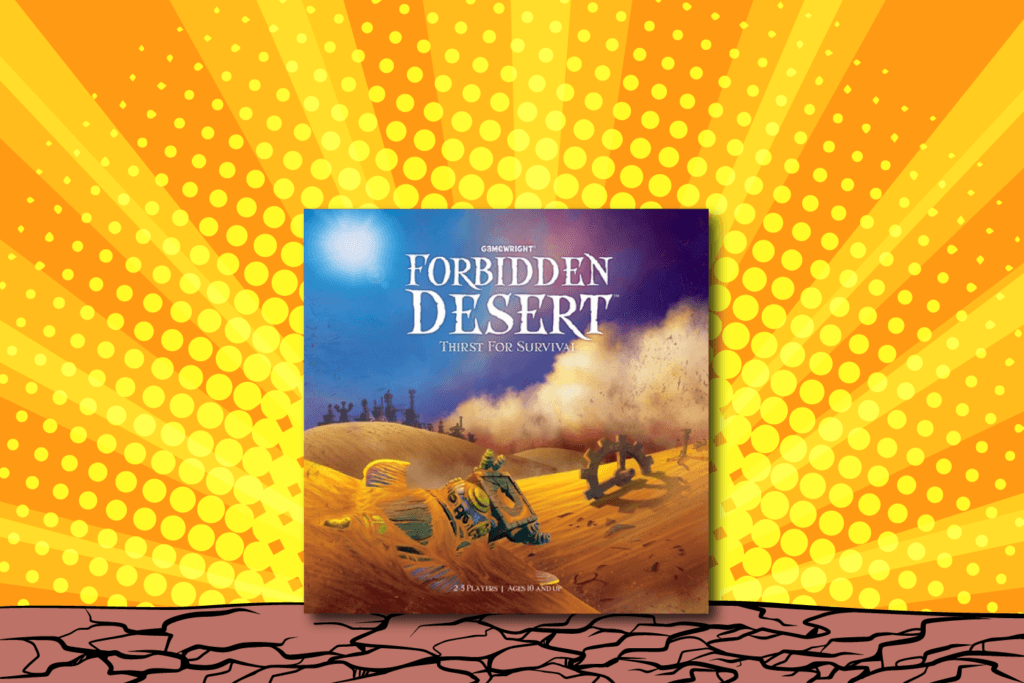
Best for: Families ready for a harder challenge
Players: 2–5
Game Type: Survival adventure
Difficulty: Easy to medium
Forbidden Desert takes the cooperative adventure formula and adds stronger survival pressure. Players are trapped in a desert, trying to assemble a flying machine before heat, sand, and storms overwhelm them.
Compared with Forbidden Island, this game feels more dynamic and slightly more challenging. The shifting storm makes the board feel alive.
Why it stands out: Great family tension, fun theme, and strong replay value.
11. Castle Panic
Best for: Families and casual groups
Players: 1–6
Game Type: Tower defense
Difficulty: Easy
Castle Panic is a cooperative tower-defense board game where players defend a castle from waves of monsters. The game is easy to teach, visually clear, and great for younger or casual players.
Players trade cards, attack monsters, and try to stop enemies before the castle walls fall. It is not the deepest game on this list, but it is one of the easiest co-op games to bring to the table.
Why it stands out: Family-friendly, simple, and fun for mixed ages.
12. Just One
Best for: Party groups and word-game fans
Players: 3–7
Game Type: Cooperative party word game
Difficulty: Easy
Just One is a cooperative party game where players give one-word clues to help someone guess a secret word. The trick is that duplicate clues get canceled.
This creates funny moments, surprising misses, and simple table energy. It works with gamers and non-gamers alike.
If you want a cooperative game for parties, holidays, or casual gatherings, Just One is one of the easiest recommendations.
Why it stands out: Fast, funny, simple, and great with almost anyone.
13. Codenames: Duet
Best for: Two-player word-game fans
Players: 2+
Game Type: Cooperative word deduction
Difficulty: Easy to medium
Codenames: Duet turns the popular Codenames system into a cooperative experience. Players give one-word clues to help each other find the right words on the grid while avoiding assassins.
It is especially good for couples and two-player teams. The game is quiet, clever, and replayable.
Why it stands out: Excellent two-player word game with simple rules and smart tension.
14. Hanabi
Best for: Small groups that enjoy logic and memory
Players: 2–5
Game Type: Cooperative card deduction
Difficulty: Medium
Hanabi is a small card game with a brilliant idea: you can see everyone’s cards except your own. Players give limited clues and try to play fireworks cards in the correct order.
The result is a quiet, thoughtful co-op game about memory, timing, and trust.
Why it stands out: Tiny box, clever design, and strong teamwork.
15. The Mind
Best for: Groups that enjoy unusual experiences
Players: 2–4
Game Type: Silent cooperative timing game
Difficulty: Easy to teach, hard to master
The Mind asks players to play numbered cards in order without talking. That sounds impossible, but the game creates a strange shared rhythm as players try to read each other’s timing.
It is not a traditional strategy game. It feels more like a group experiment. Some players love it instantly. Others may not connect with it. But it is one of the most unique cooperative card games available.
Why it stands out: Minimal rules, memorable tension, and a completely different co-op feeling.
16. Magic Maze
Best for: Real-time chaos and funny table moments
Players: 1–8
Game Type: Real-time cooperative movement
Difficulty: Easy to medium
Magic Maze is a silent real-time cooperative game where players move fantasy heroes through a shopping mall. The twist is that no one controls one character. Instead, each player controls one type of movement.
One player can move pieces north. Another can move pieces east. Another can use escalators. This creates hilarious pressure because everyone needs each other, but communication is restricted.
Why it stands out: Fast, chaotic, funny, and great for groups that like pressure.
17. Mysterium
Best for: Families, casual groups, and visual thinkers
Players: 2–7
Game Type: Cooperative mystery, clue interpretation
Difficulty: Easy
Mysterium is a beautiful cooperative mystery game where one player acts as a ghost giving dreamlike image clues. The other players try to solve the murder by identifying the correct suspect, location, and object.
The game is less about hard logic and more about interpretation, imagination, and table discussion.
Why it stands out: Gorgeous art, easy rules, and a strong group atmosphere.
18. Mysterium Park
Best for: A shorter Mysterium experience
Players: 2–6
Game Type: Cooperative mystery
Difficulty: Easy
Mysterium Park is a smaller, faster version of the Mysterium idea. It keeps the dream-clue feeling but reduces setup and playtime.
If you like the concept of Mysterium but want a lighter version, Mysterium Park is a smart choice.
Why it stands out: Faster setup, shorter playtime, same visual clue charm.
19. Detective: A Modern Crime Board Game
Best for: Mystery fans who enjoy reading and research
Players: 1–5
Game Type: Crime investigation
Difficulty: Medium
Detective is a serious cooperative investigation game where players analyze clues, follow leads, read case files, and make deductions. It feels more like a crime drama than a traditional board game.
This is a great choice for players who enjoy mystery novels, detective shows, and deeper narrative games.
Why it stands out: Strong investigation feeling and immersive case-solving.
20. Chronicles of Crime
Best for: App-assisted mystery fans
Players: 1–4
Game Type: Crime investigation, app-assisted
Difficulty: Easy to medium
Chronicles of Crime uses cards and an app to create flexible mystery cases. Players scan locations, characters, and evidence to explore the story and solve crimes.
The app makes the game fast to set up and easy to manage. It is a strong pick for people who want a modern mystery game without heavy rulebooks.
Why it stands out: Smooth app integration and accessible mystery gameplay.
21. Sherlock Holmes Consulting Detective
Best for: Serious deduction groups
Players: 1–8
Game Type: Mystery, deduction, case solving
Difficulty: Advanced
Sherlock Holmes Consulting Detective is less of a board game and more of a deep detective experience. Players read newspapers, visit locations, interview suspects, and try to solve complex cases.
It rewards careful reading, note-taking, and discussion. It is not for groups that want fast turns or lots of components. But for mystery lovers, it is a classic.
Why it stands out: Deep deduction and memorable case-solving.
22. Arkham Horror: The Card Game
Best for: Horror fans and campaign card-game players
Players: 1–4
Game Type: Living card game, campaign horror
Difficulty: Medium to advanced
Arkham Horror: The Card Game is one of the best cooperative campaign games for players who love Lovecraftian horror, deckbuilding, and story choices.
Players build investigator decks, explore locations, fight monsters, gather clues, and suffer consequences. The campaign structure creates strong narrative momentum.
It can become expensive if you collect many expansions, but the core experience is excellent.
Why it stands out: Strong theme, excellent campaigns, and deep deck customization.
23. Mansions of Madness: Second Edition
Best for: Horror groups that enjoy app-assisted adventures
Players: 1–5
Game Type: Horror adventure, app-assisted
Difficulty: Medium
Mansions of Madness puts players inside creepy mansions, strange towns, and dangerous mysteries. The app controls the scenario, reveals rooms, handles monsters, and creates a cinematic horror experience.
It is atmospheric, dramatic, and ideal for groups that want story-driven horror without one player needing to run the game.
Why it stands out: Immersive horror, strong app support, and cinematic scenarios.
24. Eldritch Horror
Best for: Big global horror adventure
Players: 1–8
Game Type: Adventure, horror, world travel
Difficulty: Medium to advanced
Eldritch Horror sends investigators around the world to stop ancient cosmic threats. The game is big, dramatic, and full of unpredictable events.
It works best for groups that enjoy long, thematic sessions with lots of story moments.
Why it stands out: Global adventure feeling and huge horror theme.
25. Horrified
Best for: Families and classic monster fans
Players: 1–5
Game Type: Cooperative monster defense
Difficulty: Easy to medium
Horrified is a friendly cooperative game where players work together to defeat classic movie monsters. Each monster has a different puzzle, so mixing monsters changes the challenge.
It is easy enough for families but interesting enough for adults.
Why it stands out: Great theme, accessible rules, and flexible difficulty.
26. Horrified: American Monsters
Best for: Groups that want a fresh Horrified setting
Players: 1–5
Game Type: Cooperative monster game
Difficulty: Easy to medium
Horrified: American Monsters keeps the same approachable co-op structure but changes the monster lineup and atmosphere.
It is a strong pick if your group already likes Horrified and wants new challenges.
Why it stands out: Familiar system with fresh monster puzzles.
27. The Lord of the Rings: Journeys in Middle-earth
Best for: Tolkien fans who want campaign adventure
Players: 1–5
Game Type: App-assisted campaign adventure
Difficulty: Medium
Journeys in Middle-earth lets players explore Middle-earth through campaign scenarios managed by an app. Players control heroes, move across map tiles, fight enemies, gain skills, and follow a story.
It is a good choice for groups that want fantasy adventure with less bookkeeping.
Why it stands out: Strong theme, campaign structure, and app-assisted storytelling.
28. The Lord of the Rings: The Card Game
Best for: Deckbuilding and Tolkien fans
Players: 1–4
Game Type: Cooperative living card game
Difficulty: Medium to advanced
The Lord of the Rings: The Card Game is a cooperative deck-construction game where players build decks around heroes and face scenario challenges.
It is deeply replayable and rewarding, especially for players who enjoy customizing decks.
Why it stands out: Excellent solo/co-op play and strong deckbuilding depth.
29. Marvel Champions: The Card Game
Best for: Superhero fans and flexible co-op card play
Players: 1–4
Game Type: Cooperative living card game
Difficulty: Medium
Marvel Champions lets players become Marvel heroes and battle villains through card-driven scenarios. It is easier to jump into than some living card games, and each hero feels different.
It works well solo, two-player, or with a group.
Why it stands out: Fast setup, strong hero identity, and lots of expansion options.
30. Aeon’s End
Best for: Deckbuilding fans who want teamwork
Players: 1–4
Game Type: Cooperative deckbuilding
Difficulty: Medium
Aeon’s End is a cooperative deckbuilding game where players fight powerful monsters called Nemeses. Unlike many deckbuilders, you do not shuffle your discard pile when it becomes your deck. That means card order matters.
The game feels tactical and tense, especially because the enemy can hit hard.
Why it stands out: Smart deckbuilding, unique turn order, and strong boss battles.
31. Aeon’s End: Legacy
Best for: Groups that want a deckbuilding campaign
Players: 1–4
Game Type: Legacy deckbuilding
Difficulty: Medium
Aeon’s End: Legacy introduces players gradually to the Aeon’s End system while giving them a campaign experience. You unlock content, develop characters, and face evolving threats.
It is a good entry point for players who like deckbuilding but want progression.
Why it stands out: Campaign progression with satisfying cooperative deckbuilding.
32. Too Many Bones
Best for: Premium tactical dice adventure
Players: 1–4
Game Type: Dice-building adventure, tactical combat
Difficulty: Advanced
Too Many Bones is a big, premium cooperative adventure game with unique characters, tactical battles, dice progression, and a strong fantasy style.
Each character has a different skill system, which gives the game huge replay value. It is not cheap or simple, but it rewards committed players.
Why it stands out: Unique character builds, premium components, and deep tactical choices.
33. Mage Knight Board Game
Best for: Heavy solo and co-op strategy fans
Players: 1–4
Game Type: Adventure, deckbuilding, exploration
Difficulty: Advanced
Mage Knight is a legendary heavy board game where players explore, build decks, fight enemies, conquer cities, and grow in power.
It is famous as a solo game, but it can also be played cooperatively. The learning curve is steep, but the payoff is huge for players who enjoy deep systems.
Why it stands out: Massive strategic depth and one of the richest adventure systems in board gaming.
34. Robinson Crusoe: Adventures on the Cursed Island
Best for: Survival game fans
Players: 1–4
Game Type: Cooperative survival adventure
Difficulty: Advanced
Robinson Crusoe is a tough cooperative survival game where players gather resources, build shelter, explore, craft tools, and try to survive dangerous scenarios.
This game can be brutal. Bad weather, wounds, hunger, and unlucky events can crush your plans. But that is part of the appeal.
Why it stands out: Strong survival theme and dramatic storytelling through gameplay.
35. This War of Mine: The Board Game
Best for: Mature groups looking for emotional storytelling
Players: 1–6
Game Type: Survival, narrative, war drama
Difficulty: Advanced
This War of Mine is a dark cooperative survival game about civilians trying to survive in a city under siege. It is not a light entertainment game. It is serious, emotional, and sometimes uncomfortable.
Players manage food, shelter, danger, morale, and impossible choices.
Why it stands out: Powerful theme and difficult moral decisions.
36. Paleo
Best for: Families and groups who like survival puzzles
Players: 2–4
Game Type: Prehistoric survival
Difficulty: Medium
Paleo puts players in a prehistoric tribe trying to survive, gather resources, avoid danger, and complete goals. The game uses card decks to create uncertainty and discovery.
It has a nice balance of accessibility and challenge.
Why it stands out: Great theme, modular scenarios, and smart teamwork.
37. The Grizzled
Best for: Small groups that want emotional tension
Players: 2–5
Game Type: Cooperative card survival
Difficulty: Medium
The Grizzled is a small but powerful cooperative card game about soldiers trying to survive World War I. Players must manage threats, morale, and support for one another.
It is not about winning battles. It is about enduring.
Why it stands out: Small box, serious theme, and meaningful cooperation.
38. Flash Point: Fire Rescue
Best for: Families and disaster-rescue fans
Players: 2–6
Game Type: Firefighting rescue
Difficulty: Easy to medium
Flash Point is a cooperative game where players are firefighters rescuing people from a burning building. Fire spreads, smoke builds, walls collapse, and victims need help fast.
The theme is easy to understand, and the game includes ways to adjust difficulty.
Why it stands out: Exciting rescue theme and family-friendly teamwork.
39. Burgle Bros.
Best for: Heist fans
Players: 1–4
Game Type: Cooperative stealth heist
Difficulty: Medium
Burgle Bros. is a cooperative heist game where players sneak through a building, avoid guards, crack safes, and escape with loot.
The game creates fun cinematic moments. Plans go wrong, guards move unexpectedly, and the team has to improvise.
Why it stands out: Strong heist theme and clever stealth gameplay.
40. Burgle Bros. 2: The Casino Capers
Best for: Groups that want a bigger heist sequel
Players: 1–4
Game Type: Cooperative heist
Difficulty: Medium
Burgle Bros. 2 moves the action into a casino setting with new rooms, new twists, and more dramatic finales. It keeps the cooperative stealth feeling while adding fresh challenges.
Why it stands out: More cinematic heist moments and a fun casino theme.
41. Sub Terra
Best for: Groups that enjoy tense exploration
Players: 1–6
Game Type: Cave survival, tile exploration
Difficulty: Medium
Sub Terra is a cooperative survival game where players are trapped in a cave system trying to find the exit. The cave is dangerous, and every turn can bring floods, gas, cave-ins, or horror.
The game is tense, simple to understand, and atmospheric.
Why it stands out: Strong survival pressure and suspenseful exploration.
42. Dead Men Tell No Tales
Best for: Pirate adventure fans
Players: 2–5
Game Type: Cooperative pirate raid
Difficulty: Medium
Dead Men Tell No Tales has players boarding a burning pirate ship to collect treasure before everything explodes or collapses.
The theme is fun, the pressure builds quickly, and players must balance fighting enemies, managing fire, and escaping with loot.
Why it stands out: Pirate theme with strong cooperative pressure.
43. Ghost Stories
Best for: Groups that want a hard co-op challenge
Players: 1–4
Game Type: Defensive fantasy horror
Difficulty: Advanced
Ghost Stories is a tough cooperative game where players defend a village from waves of ghosts. The game is known for being difficult, but that difficulty creates memorable wins.
This is not the best first co-op game for beginners, but experienced players who enjoy pressure may love it.
Why it stands out: Brutal challenge and tense defensive gameplay.
44. Zombicide: Second Edition
Best for: Zombie action and dice-chucking fun
Players: 1–6
Game Type: Tactical zombie survival
Difficulty: Medium
Zombicide is loud, action-heavy, and easy to enjoy if your group wants to fight hordes of zombies. Players search for weapons, complete objectives, and try not to get overwhelmed.
It is less about quiet puzzle-solving and more about cinematic zombie chaos.
Why it stands out: Fun action, lots of scenarios, and strong group energy.
45. Cthulhu: Death May Die
Best for: Action-horror players
Players: 1–5
Game Type: Tactical horror action
Difficulty: Medium
Cthulhu: Death May Die is a cooperative action game where investigators fight cultists and cosmic horrors. Unlike slower investigation games, this one throws players into direct conflict.
It is pulpy, dramatic, and full of big moments.
Why it stands out: Fast horror action and exciting boss battles.
46. Nemesis: Lockdown
Best for: Semi-co-op horror fans who accept betrayal risk
Players: 1–5
Game Type: Sci-fi horror, survival
Difficulty: Advanced
Nemesis: Lockdown is often described as semi-cooperative rather than fully cooperative because players may have secret objectives. Still, it belongs in this list as a strong pick for groups who like cooperation mixed with suspicion.
Players survive in a facility filled with alien threats, danger, and hidden agendas.
Why it stands out: Incredible tension and cinematic sci-fi horror.
47. The LOOP
Best for: Players who want quirky time-travel co-op
Players: 1–4
Game Type: Cooperative strategy, time travel
Difficulty: Medium
The LOOP is a colorful cooperative game where players fight a villain across time. It uses deck mechanics, board control, and combo turns to create a playful but strategic experience.
It has a unique personality and stands out visually.
Why it stands out: Fun theme, clever combos, and bright table presence.
48. Mechs vs. Minions
Best for: Programming-game fans
Players: 2–4
Game Type: Cooperative programming campaign
Difficulty: Medium
Mechs vs. Minions is a cooperative programming game where players control mechs fighting waves of minions. You program actions, make mistakes, crash into things, and try to complete scenario goals.
The production quality is excellent, and the campaign structure keeps things fresh.
Why it stands out: Funny chaos, great components, and satisfying programmed movement.
49. Project: ELITE
Best for: Real-time action fans
Players: 1–6
Game Type: Real-time tactical combat
Difficulty: Medium
Project: ELITE is a fast real-time cooperative game where players fight alien waves under time pressure. It feels more like an action game than a traditional slow board game.
If your group likes adrenaline, dice, and chaos, this is a strong pick.
Why it stands out: Real-time excitement and high-energy teamwork.
50. Space Alert
Best for: Real-time planning and sci-fi chaos
Players: 1–5
Game Type: Real-time cooperative programming
Difficulty: Medium to advanced
Space Alert puts players on a spaceship under attack. The team plans actions in real time, then watches everything resolve afterward.
The fun comes from realizing what went wrong. Someone forgot to power the shields. Someone fired too early. Someone took the elevator at the wrong time.
Why it stands out: Brilliant real-time teamwork and hilarious failure.
51. MicroMacro: Crime City
Best for: Casual mystery and visual puzzle fans
Players: 1–4
Game Type: Cooperative observation mystery
Difficulty: Easy
MicroMacro: Crime City gives players a giant black-and-white city map filled with tiny details. You solve cases by following characters, tracking events, and spotting clues.
It is simple, clever, and easy to introduce to almost anyone.
Why it stands out: Unique visual puzzle style and relaxed cooperative investigation.
52. Unlock!
Best for: Escape-room fans
Players: 1–6
Game Type: Escape-room card game
Difficulty: Easy to medium
Unlock! is a series of cooperative escape-room games using cards and an app. Players solve puzzles, combine items, discover codes, and race against time.
Each box usually includes multiple scenarios, making it a good pick for groups that enjoy puzzle nights.
Why it stands out: Portable escape-room feel with lots of scenario variety.
53. Exit: The Game
Best for: One-time escape-room experiences
Players: 1–4
Game Type: Escape-room puzzle
Difficulty: Varies by box
Exit games are cooperative puzzle experiences designed to be played once. Players fold, cut, write, decode, and solve puzzles using physical components.
They are not replayable in the normal sense, but they can be excellent for a focused puzzle night.
Why it stands out: Strong puzzles and hands-on escape-room creativity.
54. The Gang
Best for: Poker fans and light strategy groups
Players: 3–6
Game Type: Cooperative poker-style deduction
Difficulty: Easy to medium
The Gang is a cooperative game inspired by poker hand evaluation. Players try to rank their hands correctly without normal table talk. It creates a surprising amount of tension from a simple idea.
It works well for groups that like card logic but want something fresh and social.
Why it stands out: Easy to learn, clever cooperation, and strong group interaction.
55. Daybreak
Best for: Players interested in climate strategy
Players: 1–4
Game Type: Cooperative climate strategy
Difficulty: Medium
Daybreak is a cooperative game about addressing climate change. Players represent world powers working together to reduce emissions, build resilience, and handle global crises.
It is thoughtful, modern, and different from the usual fantasy or horror co-op themes.
Why it stands out: Relevant theme, meaningful choices, and a fresh cooperative challenge.
Best Cooperative Board Games by Player Type
| Player Type | Recommended Games |
| New players | Pandemic, Forbidden Island, Just One, Castle Panic |
| Families | Forbidden Desert, Horrified, Flash Point, Bomb Busters |
| Couples | Sky Team, Codenames: Duet, The Crew, Hanabi |
| Strategy gamers | Spirit Island, Mage Knight, Robinson Crusoe, Too Many Bones |
| Campaign groups | Jaws of the Lion, Pandemic Legacy, Arkham Horror LCG |
| Horror fans | Mansions of Madness, Eldritch Horror, Cthulhu: Death May Die |
| Party groups | Just One, Magic Maze, The Mind, Mysterium |
| Puzzle lovers | Bomb Busters, Unlock!, Exit, MicroMacro |
| Fantasy fans | Gloomhaven, Fate of the Fellowship, Journeys in Middle-earth |
| Solo players | Spirit Island, Mage Knight, Marvel Champions, Daybreak |
Best Cooperative Board Games for Beginners
If your group is new to modern board games, start with titles that have simple rules and quick turns.
Best beginner picks:
- Forbidden Island
- Pandemic
- Just One
- Castle Panic
- Horrified
- Codenames: Duet
- The Mind
- Mysterium Park
- Flash Point
- Bomb Busters
These games are easier to teach and do not require a group to study a long rulebook before having fun.
Best Heavy Cooperative Board Games
If your group likes deep strategy, these are better choices:
- Spirit Island
- Mage Knight
- Too Many Bones
- Robinson Crusoe
- Arkham Horror: The Card Game
- Gloomhaven: Jaws of the Lion
- Eldritch Horror
- This War of Mine
- The Lord of the Rings: The Card Game
- Daybreak
Heavy co-op games are more demanding, but they often create the most satisfying wins.
Best Two-Player Cooperative Board Games
Two-player co-op games need balance. Both players should feel involved.
Top two-player co-op picks:
| Game | Why It Works for Two |
| Sky Team | Designed specifically for two players |
| Codenames: Duet | Smart wordplay and quiet teamwork |
| The Crew: Mission Deep Sea | Excellent card coordination |
| Spirit Island | Deep strategy with two spirits |
| Arkham Horror: The Card Game | Strong campaign play |
| Marvel Champions | Flexible hero combinations |
| The Lord of the Rings: The Card Game | Great deckbuilding depth |
| Hanabi | Simple but tense |
| Pandemic | Classic two-player co-op |
| Bomb Busters | Strong deduction at small counts |
Best Family Cooperative Board Games
Families often need games that are easy to explain, visually clear, and not too punishing.
Best family co-op games:
- Forbidden Island
- Forbidden Desert
- Castle Panic
- Horrified
- Flash Point: Fire Rescue
- Just One
- Mysterium Park
- Bomb Busters
- Magic Maze
- MicroMacro: Crime City
For younger kids, choose games with clear goals and shorter playtimes. For older kids and teens, Pandemic, Sky Team, and The Crew can work very well.
Best Cooperative Board Games for Adults
Adults often enjoy stronger themes, deeper choices, and longer sessions.
Best adult co-op games:
- Spirit Island
- Pandemic Legacy: Season 1
- Gloomhaven: Jaws of the Lion
- Arkham Horror: The Card Game
- Mansions of Madness
- Sherlock Holmes Consulting Detective
- Robinson Crusoe
- This War of Mine
- Fate of the Fellowship
- Daybreak
These games offer more strategic weight, stronger storytelling, or mature themes.
How to Choose the Right Cooperative Board Game
Before buying a cooperative board game, ask these questions:
| Question | Why It Matters |
| How many players will usually play? | Some games shine at specific player counts |
| How long do you want each session to last? | Co-op games can range from 15 minutes to 3 hours |
| Does your group like reading and story? | Mystery and campaign games often need patience |
| Do you want a one-off game or a campaign? | Legacy and campaign games need commitment |
| Does anyone dislike high difficulty? | Some co-op games are intentionally brutal |
| Do you want hidden information? | Hidden info reduces quarterbacking |
| Is theme important? | Strong themes make co-op games more memorable |
| Will kids play? | Choose simpler, shorter, more visual games |
| Do you want replayability? | Avoid one-time escape games if replay matters |
| Do you mind using an app? | Some modern co-op games require or benefit from apps |
Common Cooperative Board Game Mistakes to Avoid
Co-op games are fun, but choosing the wrong one can ruin the night.
Avoid these mistakes:
- Buying a heavy game for total beginners
- Choosing a long campaign for a group that rarely meets
- Ignoring player count
- Picking a horror game for players who dislike dark themes
- Buying an app-assisted game if your group wants a screen-free night
- Choosing a very hard game for casual family play
- Letting one player make every decision
- Starting with expansions before learning the base game
- Ignoring setup time
- Buying based only on ranking instead of group taste
The best cooperative board game is not always the highest-ranked game. It is the game your group will actually play.
Final Verdict: What Is the Best Cooperative Board Game in 2026?
If you want the best overall cooperative board game in 2026, choose Spirit Island. It has deep strategy, strong teamwork, high replay value, and a theme that feels different from most co-op games.
If you want a beginner-friendly classic, choose Pandemic.
If you want the best two-player co-op game, choose Sky Team.
If you want a campaign, choose Gloomhaven: Jaws of the Lion or Pandemic Legacy: Season 1.
If you want a family-friendly game, choose Forbidden Island, Horrified, or Bomb Busters.
If you want a party game, choose Just One.
The cooperative board game category is strong because it has something for every kind of table. Whether your group wants a light laugh, a tense puzzle, a serious campaign, a family adventure, or a brutal strategy challenge, there is a co-op game that fits.
The best part is simple: when the game ends, nobody has to feel defeated by another player.
You win together.
You lose together.
And usually, you immediately want to try again.
Frequently Asked Questions About Cooperative Board Games
What are cooperative board games?
Cooperative board games are games where players work together against the game system instead of competing against each other. Everyone usually wins or loses as a team.
What is the best cooperative board game in 2026?
Spirit Island is one of the best overall cooperative board games in 2026 because it offers deep strategy, strong theme, and high replayability.
What is the best cooperative board game for beginners?
Pandemic and Forbidden Island are two of the best beginner cooperative board games. Both are easy to teach and show how co-op board games work.
What is the best two-player cooperative board game?
Sky Team is one of the best two-player cooperative board games because it is designed specifically around two players working together.
What is the best cooperative board game for families?
Forbidden Island, Horrified, Castle Panic, Flash Point, and Bomb Busters are strong family cooperative board games.
What is the best cooperative campaign board game?
Pandemic Legacy: Season 1 and Gloomhaven: Jaws of the Lion are two of the best cooperative campaign board games.
Are cooperative board games good for adults?
Yes. Many cooperative board games are designed for adults, especially strategy games, mystery games, horror games, and campaign games.
Are cooperative board games good for kids?
Yes, but choose age-appropriate titles. Forbidden Island, Castle Panic, and Flash Point are good family-friendly options.
What is the alpha player problem?
The alpha player problem happens when one player controls the group and tells everyone what to do. Games with hidden information, limited communication, or simultaneous decisions help reduce this issue.
Are escape-room board games cooperative?
Yes. Games like Unlock! and Exit: The Game are cooperative puzzle games where players solve challenges together.
Can cooperative board games be played solo?
Many cooperative board games can be played solo, including Spirit Island, Marvel Champions, Arkham Horror: The Card Game, Mage Knight, and Daybreak.
What is the difference between cooperative and semi-cooperative games?
In fully cooperative games, players share the same goal. In semi-cooperative games, players may work together partly, but individual goals, betrayal, or hidden agendas can create conflict.
Are cooperative board games better than competitive board games?
Not always. It depends on the group. Cooperative games are better for players who enjoy teamwork, shared problem-solving, and lower direct conflict.
What cooperative board game should I buy first?
For most new players, Pandemic, Forbidden Island, Horrified, or Just One are safe first choices. For strategy gamers, Spirit Island is the stronger long-term pick.
What is the most replayable cooperative board game?
Spirit Island, Arkham Horror: The Card Game, Marvel Champions, Aeon’s End, and The Crew: Mission Deep Sea all offer strong replayability.
🔥 Related Posts

Word Wipe AARP – Complete Guide, Strategy, Levels, Scoring, and How to Play Online

Perfect Tidy Mobile Games: The Best Clean-Up and Organization Games for Relaxation

Most Downloaded App on Play Store: A Deep Dive into America’s Favorite App

The Ultimate Guide to the UNO Reverse Card: Meaning, Rules, Strategy & Fun Uses

The 10 Best Game Consoles for 2025 — The Complete buying Guide