Family game night sounds simple until everyone sits down and realizes they want completely different things. A younger child wants something fast. A teenager does not want to play a “little kid game.” One adult wants strategy, another wants to relax, and somebody is already asking when the pizza will arrive.
The good news is that a successful game night does not require an expensive collection or a perfectly planned schedule. It needs one activity that fits the people in the room.
This list of family game night ideas for 2026 includes familiar card games, modern board games, active challenges, creative competitions, and games you can put together with items already in your house. Some work well for a quiet school night, while others are better for a long weekend, birthday gathering, summer evening, or Thanksgiving visit with extended family.
You do not need to play all night. For many families, one main game and one quick backup game are enough. Stop while people are still having fun, and they will be more willing to play again next week.
1. Turn UNO Into a Family Tournament
UNO is easy to bring to the table because most people already understand the basic idea. Instead of playing one long game, organize several shorter rounds and award one point to each winner.
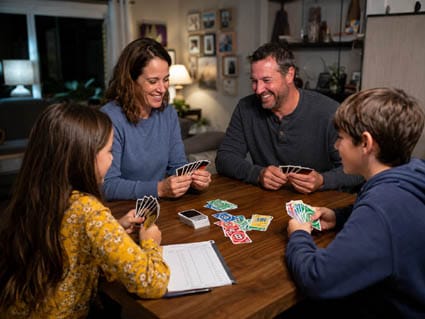
Keep the prize simple. The champion might choose dessert, pick the next family movie, or decide what game everyone plays next time. Before starting, agree on which house rules are allowed so the night does not turn into a debate about stacking Draw Two cards.
2. Play Classic Charades
Charades requires almost no setup and can be adjusted for children, teenagers, and adults. Write movies, animals, occupations, book titles, famous characters, and everyday activities on small pieces of paper.
Divide the family into teams and set a short timer for each turn. For a mixed-age group, place easier clues in one bowl and more difficult clues in another. Younger players can act out “brushing your teeth,” while adults try something more challenging.
3. Make Your Own Drawing Game
You do not need a boxed drawing game to enjoy one. Give each team paper and a marker, then prepare a list of words such as roller coaster, snowman, barbecue, school bus, camping tent, or dinosaur.
One player draws while the rest of the team guesses. The artist cannot speak, write letters, or use numbers. Bad drawings usually make this game more entertaining, so artistic ability is not an advantage.
4. Play 20 Questions
Choose one person to think of an animal, object, place, or well-known character. Everyone else gets up to 20 yes-or-no questions to identify the answer.
This game works well while you are waiting for dinner or trying to settle everyone down before a longer board game. For younger children, limit the category to something familiar, such as animals or household objects.
5. Try a Family-Friendly Would You Rather Game
Would You Rather can be funny without becoming embarrassing or inappropriate. Ask questions such as, “Would you rather have a pet dragon or a pet dinosaur?” or “Would you rather give up pizza for a year or give up dessert for a year?”
The best part is often the explanation. Give each person a chance to defend the choice, especially when the rest of the family strongly disagrees.
6. Host a Name That Tune Contest
Create a playlist with songs from different decades, movie soundtracks, television themes, children’s songs, and current family favorites. Play only the first few seconds of each track and let players guess the title or performer.
This is a good way to include several generations. Grandparents may dominate the older rounds, while teenagers take over when newer songs begin. Keep the volume reasonable and avoid using voice assistants that might announce the answer.
7. Create a Family Trivia Bowl
Write questions about topics your family actually enjoys. Mix general knowledge with sports, movies, food, U.S. geography, animals, school subjects, and family history.
Personal questions make the game memorable. Ask where Mom and Dad first met, what Grandpa’s first job was, or which family member once got lost at an amusement park. Avoid questions that could embarrass someone or start an argument.
8. Race Through a Categories Game
Choose a letter and several categories, such as food, city, animal, movie, and something found in a kitchen. Everyone has a few minutes to write one answer for each category using the selected letter.
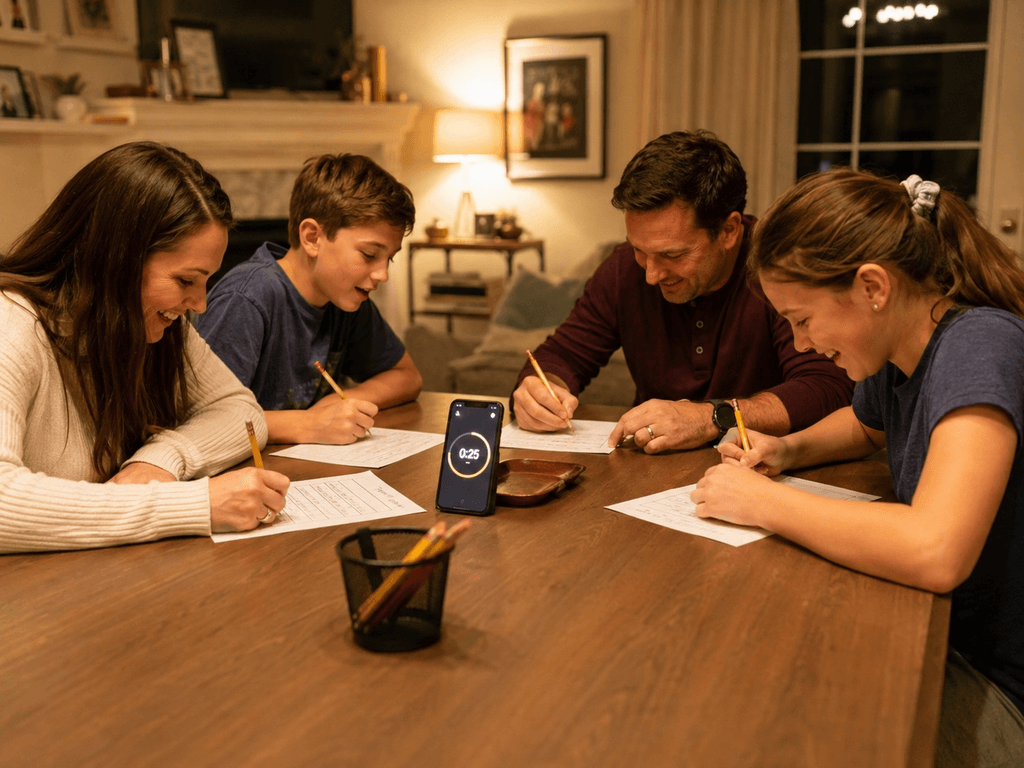
Unique answers earn more credit than answers several people wrote. This game rewards quick thinking, but it is easy to adjust for younger players by using fewer categories or allowing help from a teammate.
9. Play Two Truths and a Lie
Each person shares three statements about themselves. Two must be true, and one must be invented. The rest of the family guesses which statement is false.
This game is surprisingly effective with relatives who think they know everything about one another. Children can use simple facts, while adults may reveal harmless stories from school, work, travel, or childhood.
10. Set Up Minute-to-Win-It Challenges
Create a series of short challenges using cups, cotton balls, spoons, crackers, balloons, or other inexpensive household items. Players might stack plastic cups, move cotton balls with a spoon, or keep a balloon from touching the floor.
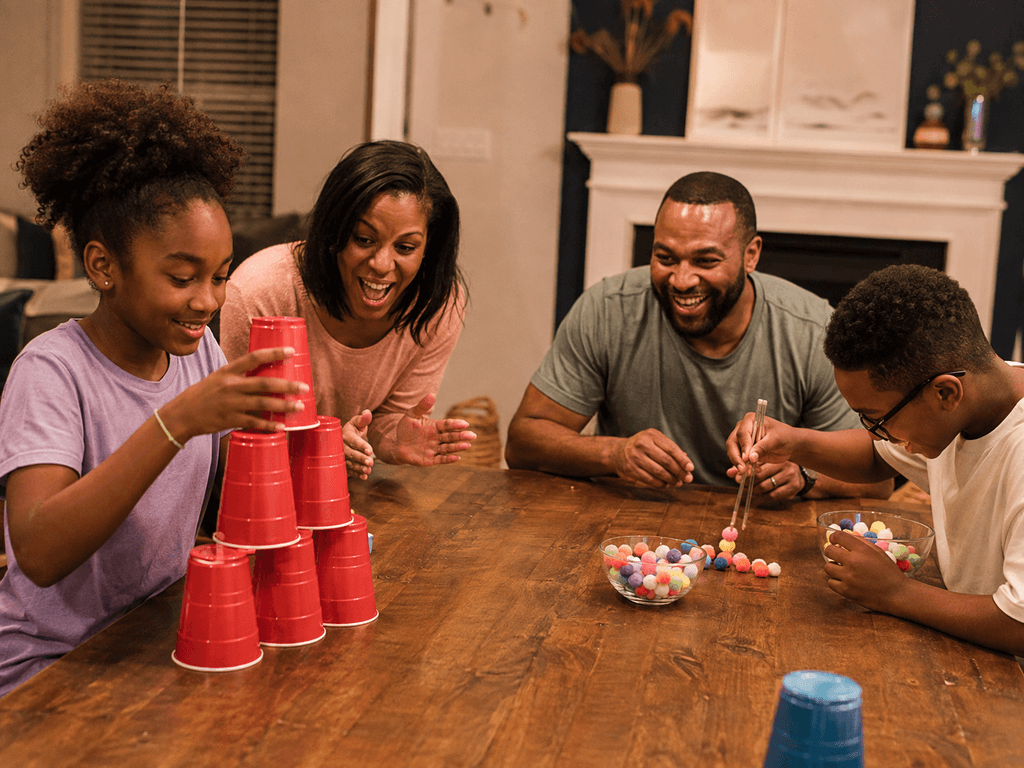
Choose activities that are safe for the room and the ages involved. A simple scoreboard turns separate challenges into a complete game night without requiring everyone to learn a complicated set of rules.
Choose activities that are safe for the room and the ages involved. A simple scoreboard turns separate challenges into a complete game night without requiring everyone to learn a complicated set of rules.
Board and Card Games for a Family Game Night
11. Play Telestrations
Telestrations combines drawing with the old telephone game. One person draws a word, the next person guesses what the drawing represents, and another person draws that guess.
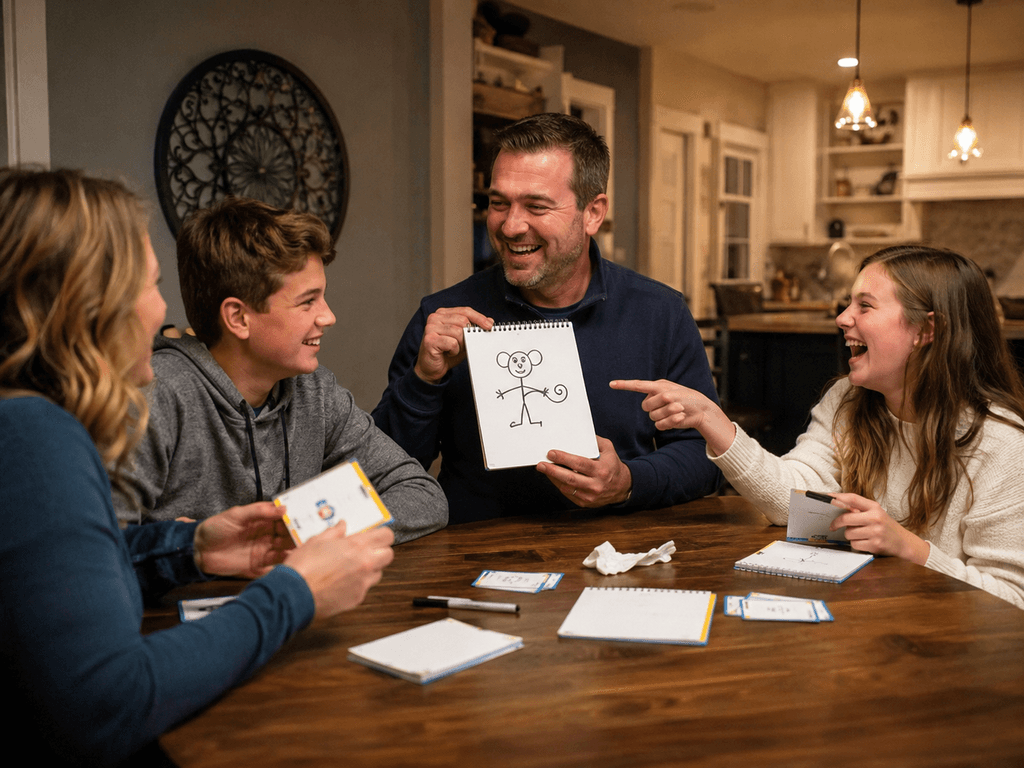
By the end of the round, an ordinary word may have turned into something completely unrelated. The reveal is usually funnier than the score, making this a strong choice for families that prefer laughing over serious competition.
12. Try Codenames With Family Teams
Codenames is built around giving short clues that connect several words on the table. One person tries to guide teammates toward the correct words without accidentally leading them toward the other team’s choices.
The game works best when players can make creative associations. For younger players, pair a child with an adult or choose simpler words before the round begins.
13. Work Together in Just One
Just One is a cooperative word-guessing game. One player tries to identify a mystery word while everyone else writes a one-word clue.
The challenge comes from thinking of a clue that is helpful without being the same as everybody else’s. Because the group is working toward a shared result, the game is a good option when competition tends to create tension.
14. Build Routes in Ticket to Ride
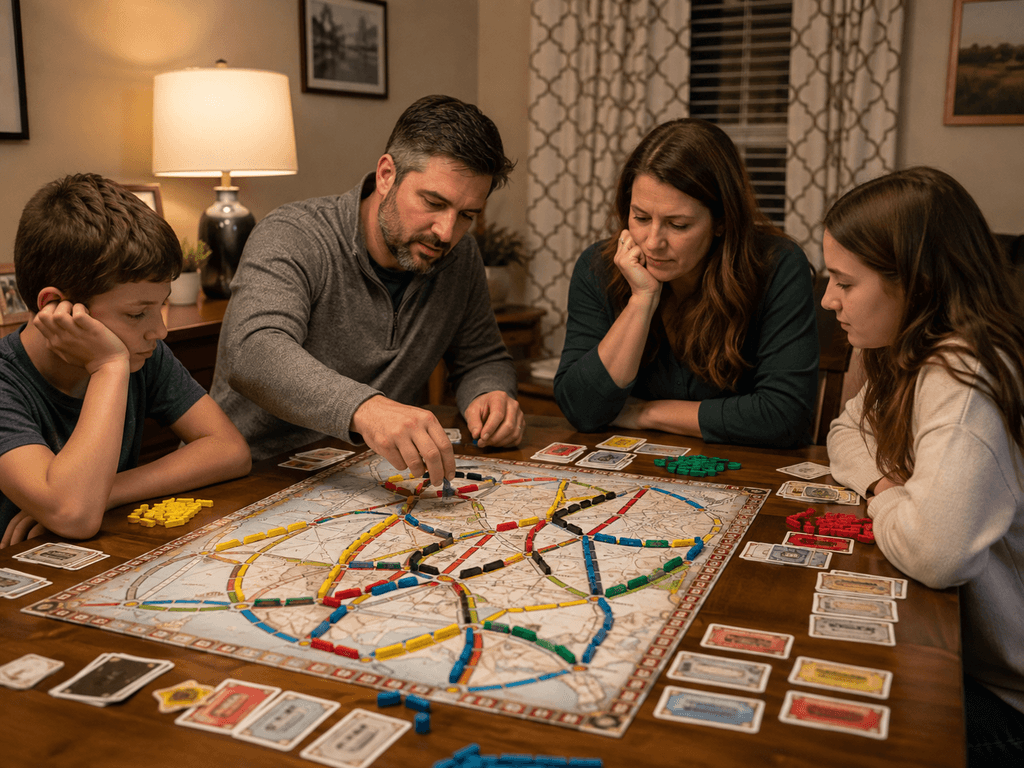
Ticket to Ride gives players a large map and a clear goal: collect cards and use them to claim railroad routes between cities. It offers enough strategy to hold an adult’s attention without requiring hours of explanation.
The U.S. map also gives the game a familiar feel for American families. Younger players may need help reading destination cards or planning longer routes, but the basic turn structure is straightforward.
15. Make Lines in Sequence
Sequence combines playing cards with a board covered in card images. Players place a chip that matches the card they played and attempt to build connected lines.
It is a useful middle-ground game when some family members enjoy cards and others prefer board games. Team play also allows younger and older relatives to sit together rather than competing separately.
16. Match Colors and Shapes in Qwirkle
Qwirkle asks players to create lines by matching colors or shapes. The rules are approachable, but deciding where to place a tile becomes more interesting as the table fills.
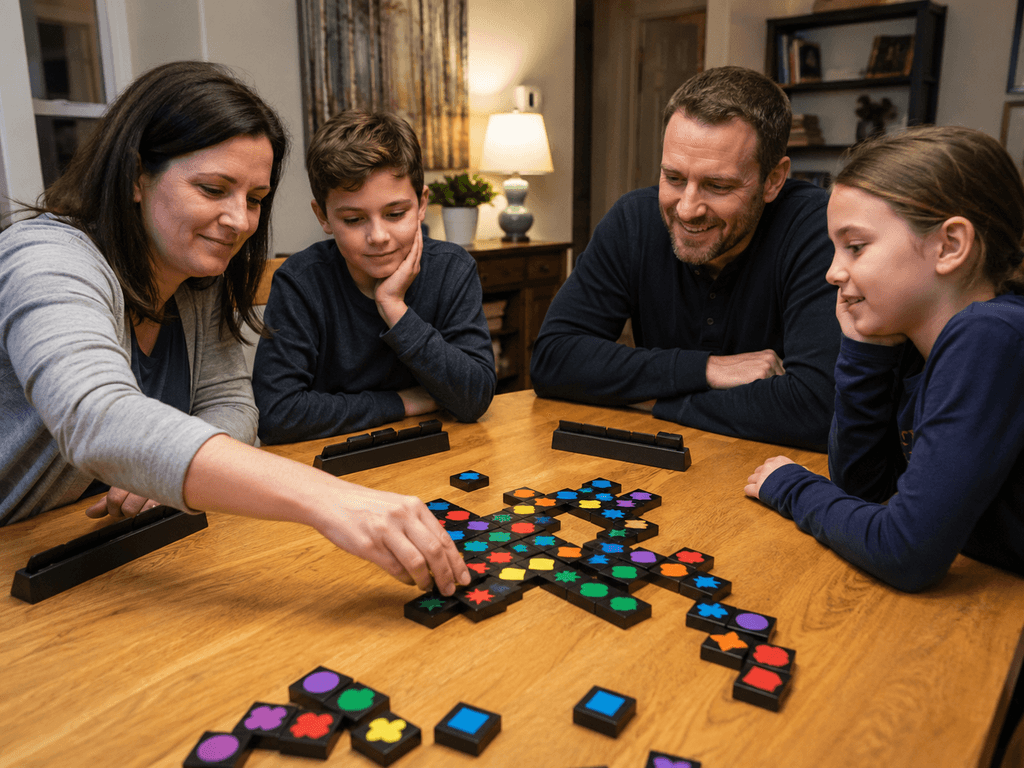
Because it relies on visual patterns instead of reading-heavy cards, it can work well in a mixed-age family group. Keep a small notepad nearby for scoring.
17. Fill the Board in Blokus
Blokus uses brightly colored pieces in different geometric shapes. Players place their pieces on the board while trying to create space for future turns and limit the options of their opponents.
It is easy to understand but difficult to play perfectly. Children can enjoy fitting the shapes together, while adults focus on blocking and long-term placement.
18. Build a Landscape in Carcassonne
In Carcassonne, players place tiles to create roads, cities, fields, and other parts of a growing landscape. No two games produce exactly the same map.
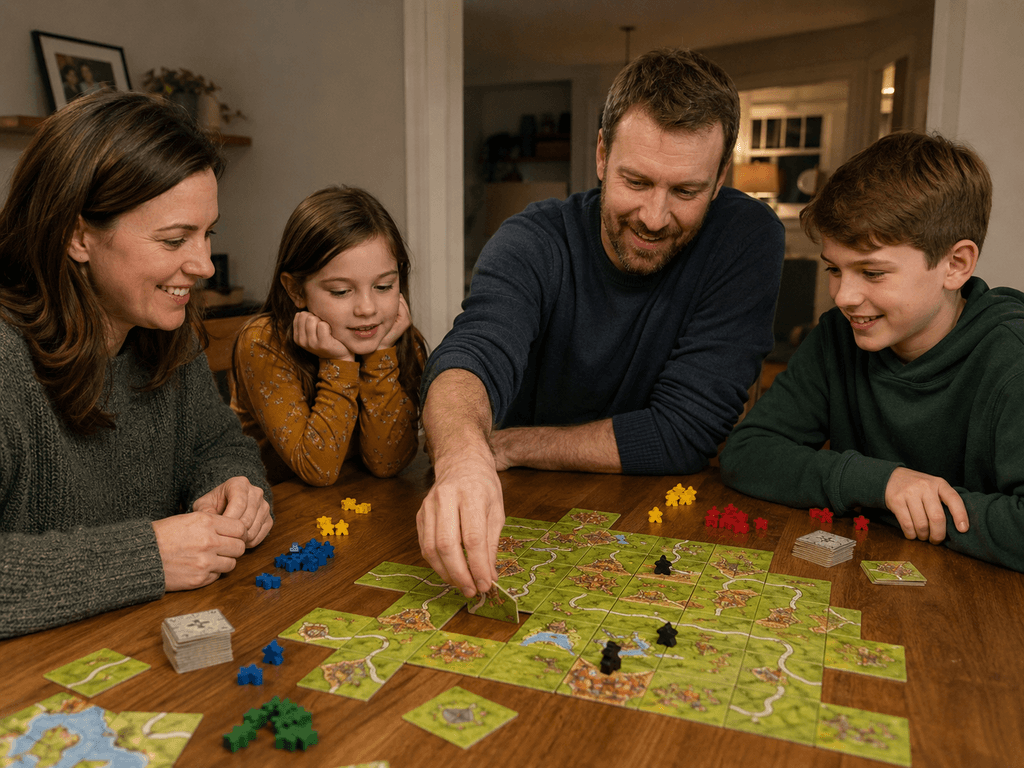
The board develops one turn at a time, which makes the game visually satisfying even for people who are not winning. New players can focus on tile placement before worrying about more advanced scoring decisions.
19. Create a Kingdom in Kingdomino
Kingdomino uses domino-shaped tiles featuring different types of land. Players connect those tiles to build a compact kingdom and earn points from matching areas.
Rounds move at a comfortable pace, and the completed kingdoms are easy to compare at the end. It is a good step up for children who are ready for more planning than a basic card game requires.
20. Draft Decorative Tiles in Azul
Azul centers on selecting colorful tiles and arranging them into patterns. The game looks inviting on the table, but players quickly discover that every choice can affect what remains available for everyone else.
It is a quieter game than charades or a party challenge. Choose it for a family that enjoys thoughtful decisions and does not mind spending a little time learning the scoring system.
21. Pass Cards Around in Sushi Go!
Sushi Go! is a quick card-drafting game in which players choose one card and pass the rest of the hand to the next person. Because the available cards keep moving, everyone stays involved.
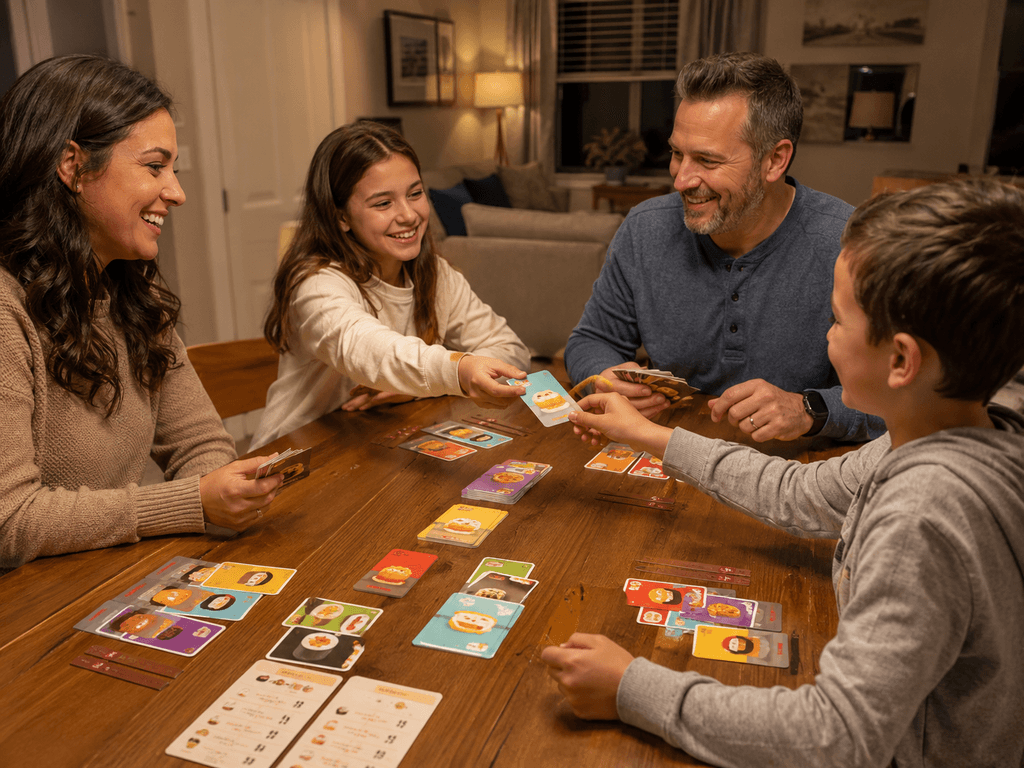
The artwork and food theme make the game feel light even when players are carefully planning their choices. It is also easy to play several rounds without turning the evening into a marathon.
22. Explore the Moving Maze in Labyrinth
Labyrinth uses a board made from sliding maze tiles. On each turn, players change the pathways and try to reach specific treasures.
The maze can shift just before someone reaches a goal, which keeps the game unpredictable. Younger children may focus on finding a path, while older players begin planning ways to alter routes for everyone else.
23. Match Funny Comparisons in Apples to Apples
Apples to Apples asks players to choose a card that best matches a word selected by the round’s judge. The “correct” answer depends on the judge’s personality, not a fixed rule.
That makes knowing your family part of the strategy. Use a family-appropriate edition and remove any card that does not fit the ages or comfort level of the group.
24. Tell Imaginative Stories With Dixit
Dixit uses illustrated cards filled with unusual, dreamlike scenes. One player gives a clue about a selected card, and everyone else contributes a card that might also match that clue.
Good clues are neither too obvious nor too confusing. The game works especially well with imaginative families who enjoy stories, art, and interpreting pictures in different ways.
25. Find the Right Spot in Wavelength
Wavelength challenges teams to guess where a hidden target sits between two opposite ideas. The scale might run from hot to cold, ordinary to strange, or useful to useless.
One player gives a clue, and the team discusses where that clue belongs on the scale. Much of the fun comes from discovering that family members interpret the same idea very differently.
Fast and Funny Game Night Ideas
26. Play Taco Cat Goat Cheese Pizza
This fast card game asks players to say a repeating series of words while turning over cards. When the spoken word matches the card, everyone races to slap the pile.
The game can become loud and competitive very quickly. Clear drinks and breakable objects off the table before starting, and remind younger players that hands—not elbows—belong on the pile.
27. Try Exploding Kittens
Exploding Kittens is a light card game built around avoiding dangerous cards while using other cards to protect yourself or disrupt another player.
The theme is silly, and the decisions are usually quick. Check the edition before playing, since different versions may have different artwork, language, or recommended audiences.
28. Get Everyone Moving With Happy Salmon
Happy Salmon is less about sitting quietly and more about finding another player who has the same action card. Matching players may high-five, switch places, or perform another simple action.
It works well as an opening game because it gets people laughing and removes some of the awkwardness from a mixed group. Move chairs and drinks out of the way first.
29. Play Throw Throw Burrito in a Safe Space
Throw Throw Burrito mixes card collecting with brief moments when players toss soft toy burritos at one another. It is energetic and intentionally ridiculous.
Use a room with enough space, remove fragile decorations, and establish clear limits before beginning. This is not the best choice for a crowded dining room or a family that takes dodgeball personally.
30. Set Up Balloon Volleyball
Tie a string across the living room or use the edge of a couch as the imaginary net. Divide the family into teams and use a balloon instead of a ball.
The balloon moves slowly enough for younger children and grandparents to participate. Add a rule that players must remain seated when space is limited.
31. Play Sock Basketball
Roll clean socks into balls and use a laundry basket as the hoop. Mark shooting lines with painter’s tape and assign different point values based on distance.
You can run free throws, team rounds, or a last-shot-wins contest. It is an easy backup activity when a board game ends earlier than expected.
32. Hold a Paper Airplane Contest
Give everyone the same size sheet of paper and a limited amount of folding time. Then test the airplanes for distance, accuracy, or time in the air.
Create separate awards so the strongest throw does not automatically win everything. “Best design” and “closest to the target” give younger players another chance to succeed.
33. Run a Cup-Stacking Relay
Set out plastic or paper cups and ask players to build and collapse a pyramid as quickly as possible. Teams can race side by side or complete the challenge one person at a time.
Add obstacles for older players, such as using only one hand. Keep the rules simpler for children so speed is not the only skill that matters.
34. Organize an Indoor Scavenger Hunt
Prepare clues that lead players from one part of the house to another. The final clue can reveal dessert, a small prize, or the next game.
For a younger group, use pictures and simple directions. Teenagers and adults will need wordplay, codes, or clues connected to family memories to keep the hunt interesting.
35. Play Flashlight Hide-and-Seek
Turn off most of the lights and give the seeker a flashlight. Everyone else hides within an agreed area of the house or backyard.
Set firm boundaries, leave stairs safely lit, and remove anything people could trip over. This version works best with older children who can follow the safety rules.
Family Game Night Ideas That Cost Almost Nothing
36. Make a Mystery Bag Guessing Game
Place familiar objects inside a pillowcase or reusable shopping bag. Players reach inside without looking and try to identify each object by touch.
Choose safe items without sharp edges. A toy car, wooden spoon, tennis ball, mitten, or measuring cup works better than anything fragile or messy.
37. Build a Story One Sentence at a Time
One person begins with a sentence such as, “At midnight, the dog opened the refrigerator and found a map.” The next person adds another sentence, and the story continues around the table.
You can record the story on a phone or write it down as it develops. Reading the completed version aloud at the end is usually the best part.
38. Build the Tallest Tower
Give each team the same materials, such as index cards, paper cups, straws, tape, or uncooked spaghetti. Set a time limit and ask everyone to build the tallest freestanding tower.
The activity becomes more interesting when materials are limited. Test each structure before declaring a winner, since a tall tower that falls immediately may not deserve first place.
39. Create a Family Survey Showdown
Before game night, ask relatives simple survey questions such as, “What food belongs at a backyard cookout?” or “What is the worst chore in the house?” Record the most common answers.
During the game, divide everyone into teams and ask them to guess the popular responses. Use a phone, index cards, or a dry-erase board to keep score.
40. Make a Kitchen-Table Escape Room
Hide several clues in envelopes and connect them into one mystery. A solved word puzzle might reveal a number, which opens another envelope and leads to the final answer.
You do not need special locks or equipment. A few printed clues, household objects, and a strong theme can create the same sense of discovery. Keep the puzzle short for the first attempt.
41. Hold a Jigsaw Puzzle Race
Choose two puzzles with similar piece counts and difficulty levels. Divide the family into teams and see who completes a puzzle first.
When matching puzzles are not available, give both teams separate sections of one larger puzzle. The team that finishes its section first earns a point, but everyone still works together to complete the full picture.
42. Organize a Blind Taste Test
Select several safe foods or drinks and ask players to identify them while blindfolded. Different potato chip flavors, fruit, soda, crackers, or ice cream can work well.
Check food allergies and dietary restrictions before preparing anything. Never surprise someone with an ingredient they avoid for medical, religious, or personal reasons.
43. Run a Family Photo Challenge
Give everyone a list of pictures to capture around the house or yard. Ideas might include something shaped like a letter, the funniest shadow, an object older than one player, or the best recreation of a movie poster.
Set a time limit, then display the photos on a television or pass the phones around. Award categories instead of choosing only one winner.
44. Host a Five-Minute Talent Show
Each person gets a few minutes to prepare a small performance. It could be a magic trick, impression, dance, joke, drawing demonstration, unusual skill, or dramatic reading.
Keep it playful rather than serious. Nobody should be pressured to perform; a reluctant family member can serve as the host, judge, timekeeper, or music operator.
45. Let the Kids Teach the Adults
Choose a game the children or teenagers know better than the adults. The younger players explain the rules, answer questions, and run the first round.
Changing the usual roles can make younger family members more invested in the evening. Adults should resist the temptation to take control as soon as the game begins.
Themed Family Game Night Ideas
46. Plan a Decades Night
Choose a decade and build the evening around it. Play music from that era, prepare a simple snack, and include trivia about movies, toys, sports, clothing, or major cultural moments.
A 1980s, 1990s, or early-2000s theme often gives adults a chance to share memories while younger players discover something unfamiliar. Keep the trivia broad enough that the game does not favor only one generation.
47. Hold a Backyard Family Olympics
Create several short events, such as a beanbag toss, relay race, hula-hoop challenge, standing long jump, water-cup race, or obstacle course.
Players can compete individually or represent teams. Include events based on accuracy and teamwork—not just running speed—so everyone has a realistic chance to contribute.
48. Turn the Dining Room Into a Board Game Café
Set out two or three games, prepare simple snacks, and make small menu cards with drink choices. Let family members rotate between games as though they were visiting a neighborhood game café.
This format works well for extended-family gatherings because everyone does not have to play the same thing. One table can host a strategy game while another runs a fast card game.
49. Choose a Cooperative Mission Night
Pick games and activities in which the family works toward one shared goal. You might complete an escape-room puzzle, solve a mystery, finish a jigsaw puzzle, or play a cooperative board game.
This is a useful change for families that become too competitive. The discussion becomes “How do we solve this?” instead of “How do I stop you from winning?”
50. Create a Family Game Night Championship
Keep a simple scorecard across several game nights. Award points for wins, teamwork, creative answers, sportsmanship, or helping set up and clean up.
Do not make winning the only way to earn points. A balanced system keeps younger children involved and prevents one strong player from taking an unbeatable lead. At the end of the month or season, present a homemade trophy that stays with the winner until the next championship.
How to Choose the Right Game for Your Family
The best game is not always the most popular or most expensive one. It is the game your particular group will actually play.
Start by considering attention span. A child who is tired after school may enjoy a 15-minute card game but lose interest during a long strategy game. Teenagers may participate more willingly when they help choose the game instead of being told what the family is playing.
Think about competition as well. Some families enjoy dramatic wins and losses. Others have a much better evening with cooperative games, team play, or activities that award several different prizes.
It also helps to prepare one backup option. A game may take longer to explain than expected, require more players, or simply fail to connect with the group. A deck of cards, charades list, or quick drawing challenge can rescue the evening.
Finally, keep food simple. Pizza, popcorn, pretzels, cookies, and bite-sized snacks are easier to manage than a full meal spread. Keep greasy foods and open drinks away from cards, boards, and electronics.
How to Keep Teenagers Interested in Family Game Night
Teenagers are more likely to join when the evening does not feel designed only for younger children. Give them a real role in choosing the game, building the playlist, making trivia questions, or organizing the tournament.
Avoid forcing every activity to be completely screen-free. A phone can be useful for music, timers, photo challenges, scorekeeping, or displaying clues. The goal is spending time together, not proving that every screen is bad.
It also helps to keep the event reasonably short. A teenager may agree to an hour of games more readily than an undefined evening that could continue until bedtime.
🔥 Related Posts

Top Celebrity-Endorsed Mobile Games in 2025

Why Did Flappy Bird Get Banned? The Shocking Truth Behind the Viral Game’s Disappearance

Top 10 Mobile Games in the World: Must-Play Titles for Every Gamer

Xbox Controller: The Complete Guide to Features, Compatibility, Setup, and Buying Tips

Top 10 Mobile Games That Secretly Teach You Life Skills